
Red-tailed Hawk
Buteo jamaicensis
Identify a Red-tailed Hawk by its broad wings, dark leading-edge marks, and adult tail. Hear its scream and find it across the U.S.

The short answer
Look for a sturdy hawk with broad, rounded wings, a short fan-shaped tail, and dark marks along the inner leading edges of the underwings. Many adults show a rusty tail from above. Juveniles have a brown, finely barred tail.
When a hawk circles high enough that you can’t see its tail color, look for two dark slashes near the front edges of the wings. Those marks often give you a better answer than waiting for a red tail.
Identify a bird
Free photo or sound ID. No signup.
On this page8 min read
How to identify a Red-tailed Hawk
From below, check the leading edge of each wing between the body and the bend in the wing. Often it forms a dark bar against paler feathers. Many pale birds also show a band of dark streaks across the belly, below a clearer upper chest.
Plumage varies widely, especially out West. A dark bird may hide the belly band, and a young bird can lack the rusty tail entirely. Use wing shape, the underwing pattern when visible, and the proportions of the tail together.
Find the field marks
Choose a marker to see what to look for.- Streaked lower breast
This bird’s pale chest gives way to darker streaks below it. The contrast is often more obvious from the front.
- Tail below the wings
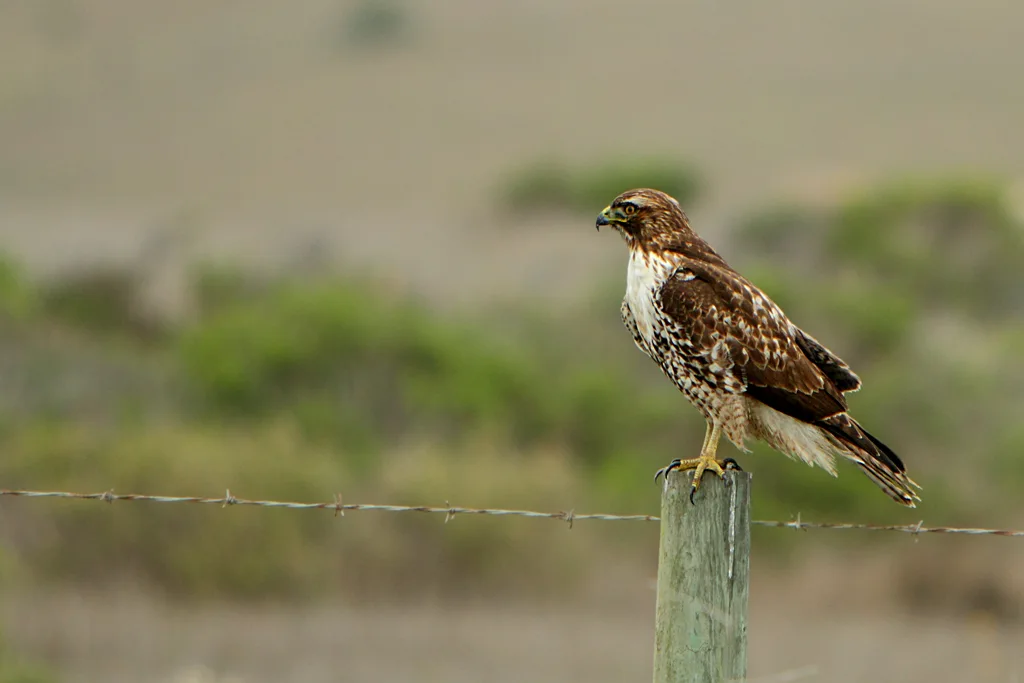
From a perch, note where the folded wing ends and the tail continues. The shade of the tail is clearer when the bird banks.
Pale bird from below
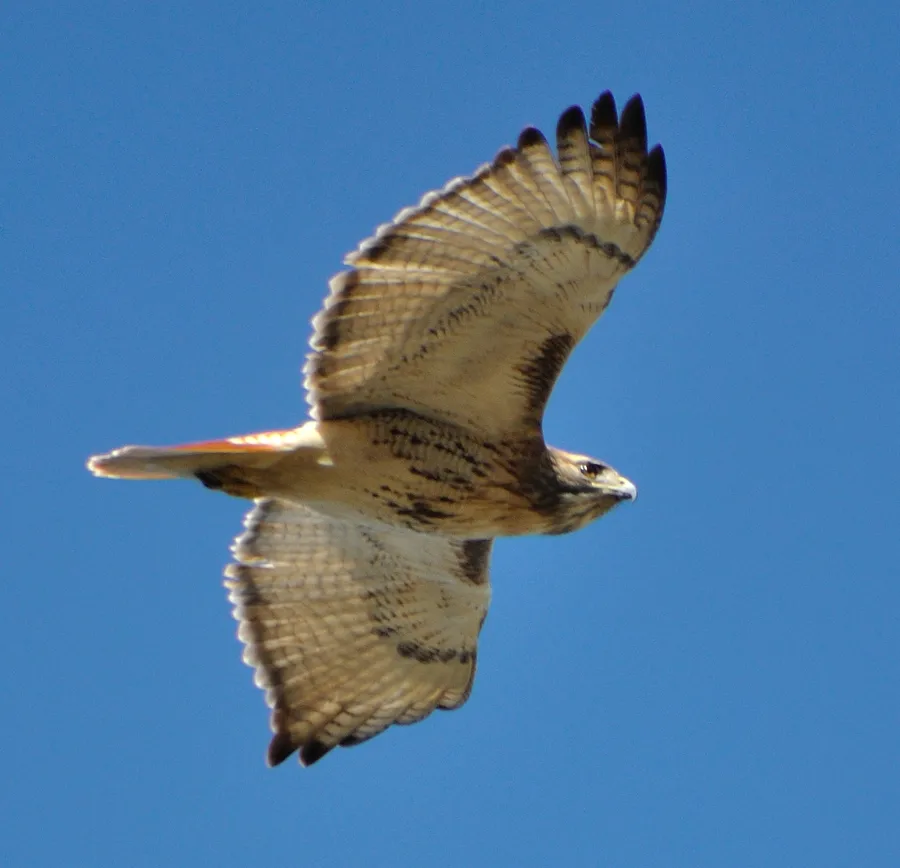
Look at where the dark marks fall on the wings. On a Red-tailed Hawk they are near the front edges of the inner wings. A streaked band across the belly can support the ID when the upper chest looks clearer.
A brown-tailed juvenile
A young Red-tailed Hawk can be fully grown and still lack the red tail. Watch for dark bars on the tail plus the broad, rounded wings. A low fly-by or a bird banking into sunlight is usually the best time to check the underside.
Dark or pale western birds
Plumage can vary sharply across the range. If a hawk has a very pale tail or dark body, take several angles if possible and use structure, the wing pattern, and the location together. A narrow view through branches may be too limited for a confident ID.
What can I identify from a silhouette?
On a perch, look at the body and how far the tail extends below the folded wings. A bulky hawk with a relatively short tail on a fence post overlooking a field is a plausible Red-tailed Hawk. The perch itself is a weak clue, so try to watch what shape the bird makes when it leaves.
When it soars, wait for a clear view of both wings and the spread tail. Look for broad, rounded wings and a short, wide tail. A single frame while the bird is turning toward you can make a fairly long tail look short. Follow a full circle before judging the proportions.
When it banks into better light, look for a dark bar near the front of each wing, between the body and wrist. The same turn may give you a look at the upper tail, where the rusty color is easiest to see on many adults. If the bird stays backlit and the outline is all you have, stop at a likely broad-winged hawk and leave the species open.

Size and wingspan
- Length
- 17–26 in
- Wingspan
- 45–52 in
- Weight
- 24–52 oz
Measurements from Audubon’s field guide.
Red-tailed Hawk sounds
The best-known sound is a rough, descending scream. It may come from a bird soaring, defending a territory, or calling near the nest. The field recording gives a short example of the harsh tone.
A perched roadside hawk can be silent through a long watch. If a scream has drawn your attention, scan both the sky and exposed perches to see which bird is calling.
Jonathon Jongsma · CC BY-SA 3.0 · Browse more bird calls
What to listen for
A rough descending scream lasts longer than the small chips of nearby songbirds. Wait to see whether it follows a bird circling across your view or comes from a bird staying near a perch. A young hawk near the nest can also call repeatedly.
Reported Red-tailed Hawk sightings
Contiguous U.S. · 2020–2024- 0
- <40
- 40–<80
- 80–<120
- 120–<180
- 180+
Reports by month
Show the data table
| Month | Reports | Per 10,000 |
|---|---|---|
| January | ||
| February | ||
| March | ||
| April | ||
| May | ||
| June | ||
| July | ||
| August | ||
| September | ||
| October | ||
| November | ||
| December |
State colors show sightings per 10,000 bird reports, adjusted for differences in reporting by place and month. Use the rates to compare reports across the map. Data from Cornell’s eBird Observation Dataset via GBIF (CC BY 4.0) with U.S. Census Bureau state boundaries. See the species on eBird.
Where and when to look in the U.S.
Red-tailed Hawks occur across the United States. Look over open fields, grasslands, or wooded edges, and check lone trees, poles, and fence posts facing open hunting ground.
Many remain in the same area throughout the year, while some northern birds move south in fall. On a bright day, watch after the ground warms and birds start to circle on rising air.
California in January
Look along the edges of a valley field or grassland from a safe trail or pull-off. Scan lone trees and fence lines, then watch which direction the birds take when they leave a perch.
84,038 reports in 2020–2024, or 173.4 per 10,000 bird reports in that state and month.
Show California in January on the mapNew York in October
From a trail or public overlook, watch above an open ridge or wide field. October migrants may pass high, so compare wings and tail as each bird banks and turns across the light.
26,711 reports in 2020–2024, or 115.9 per 10,000 bird reports in that state and month.
Show New York in October on the mapWhat does the Red-tailed Hawk eat?
Small mammals such as voles, mice, and squirrels are frequent prey. Red-tailed Hawks also take birds and reptiles. A hawk on a pole may spend several minutes watching one patch before gliding down to the ground.
Follow the view from a hunting perch
A perch facing short grass gives a clear hunting angle. If a hawk stays in place, scan the field below it and look for a change in its posture. A drop to the ground or a return carrying prey can happen in a few seconds.
Nesting and breeding
Pairs build a bulky stick nest high in a tree or on a cliff. Some use human-made structures. A pair can return to a nest site and add new sticks in later seasons.
During the breeding season, watch for a bird carrying a stick or returning with prey. Repeated trips can reveal a nest from far away without having to approach it.
From eggs to young
- Clutch1–5 eggs
A large stick nest may be reused and rebuilt. Active adults carrying sticks or spending time near the nest are better evidence than the structure on its own.
- Incubation28–35 days
An adult sitting low may show only its head over the edge. Observe from a trail or another established viewpoint.
- Young in the nest42–46 days
Older young may stand above the rim or move onto nearby limbs. Adult visits with food can be easier to see than the nest itself.
Breeding ranges and timing from the Cornell Lab’s life history account.
Behavior
The same hawk may spend part of the day hunting from a perch and later soar in broad circles. Extended, rounded wings and a fanned tail give a useful silhouette even when shade hides the plumage.
A broad circle above a slope can reveal a wing shape and a view of a tail you couldn’t see from directly below. If the bird turns repeatedly, wait for a complete pass before deciding which field marks you saw.
How long can a Red-tailed Hawk live?
The longevity record reported by the Cornell Lab is at least 30 years, 8 months. Individual birds often live much shorter lives.
Conservation
The Red-tailed Hawk is widespread. Open hunting areas near secure perches and nest sites support it in both rural and developed landscapes.
Red-tailed Hawk or Red-shouldered Hawk?
Check the outer wings and tail in a soaring adult. A Red-shouldered Hawk often shows pale crescents near its wingtips and a dark tail crossed by narrow white bands. A Red-tailed Hawk usually has a heavier shape and a shorter, broader-looking tail.
| Clue | Red-tailed Hawk | Red-shouldered Hawk |
|---|---|---|
| Inner wings | Often has dark marks along the front edges near the body. | Check for pale crescents near the outer wings. |
| Adult tail | Often rusty above, with regional variation. | Typically dark with several narrow pale bands. |
| Outline | Bulkier body and wider wings. | Often slimmer with a longer-looking tail. |
Red-tailed Hawk quick facts
- Scientific name
- Buteo jamaicensis
- Family
- Accipitridae
Common questions
Does every Red-tailed Hawk have a red tail?
No. Young birds have barred brown tails. Some adults also look paler from below or have tail patterns that vary with region and plumage.
What is the hawk commonly perched on highway poles?
A Red-tailed Hawk is a common candidate. Look for a stocky body and broad wings, then check the belly band or tail if your view allows it.
Sources and credits
- Audubon field guide for field marks, measurements, habitat, diet, and nesting.
- Cornell Lab’s All About Birds species profile for longevity and life history.
- Cornell Lab of Ornithology’s eBird species account for occurrence and species reference material.
- Lead photo by Alan Vernon · converted to WebP · CC BY 2.0 · resized.
- Recording by Jonathon Jongsma · CC BY-SA 3.0.