

Blue Jay
Cyanocitta cristata
Identify a Blue Jay by its crest, black necklace, and white wing marks. Hear its call and find out where it lives, what it eats, and where it nests.

The short answer
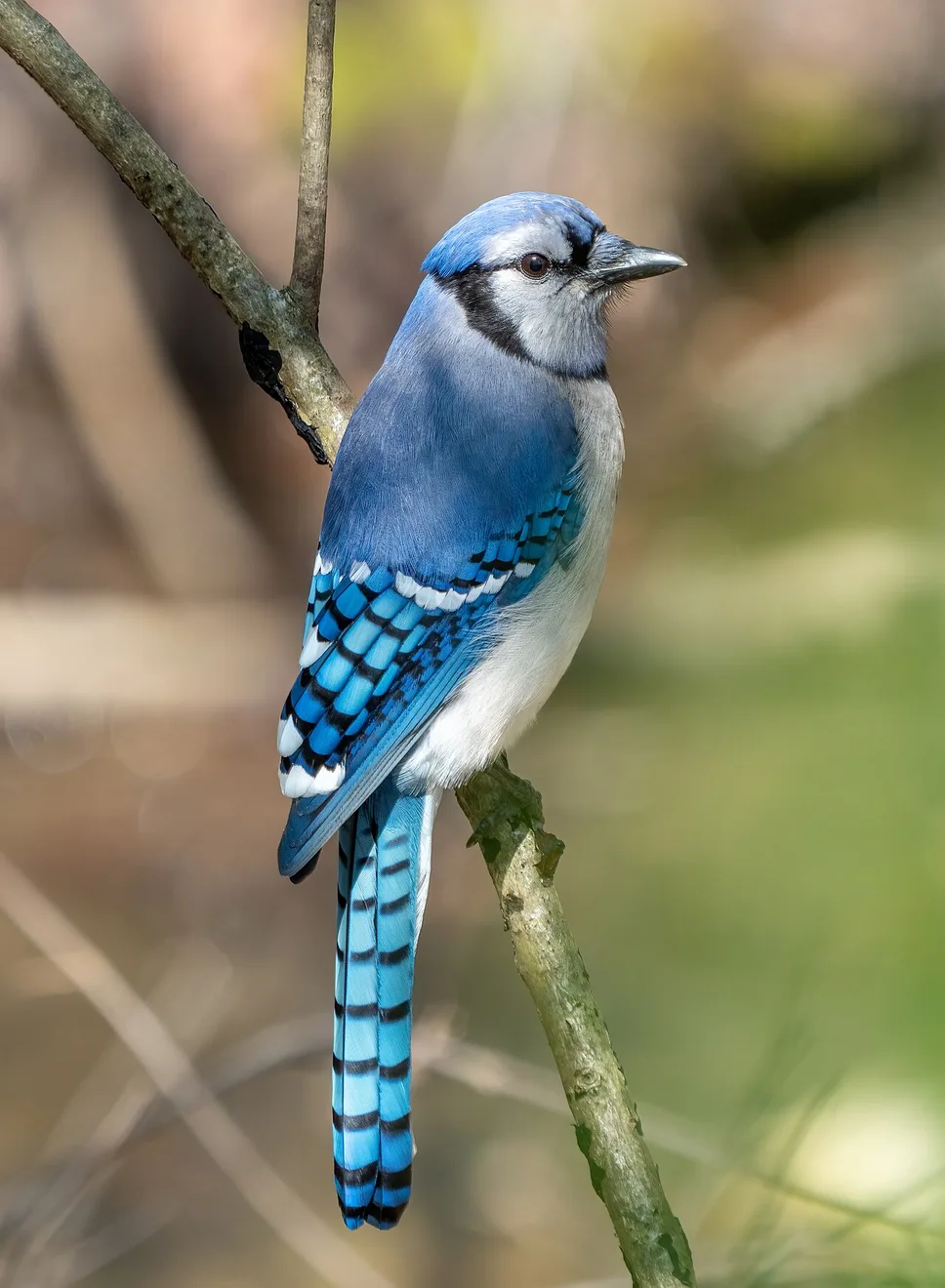
A Blue Jay has a blue crest, a dark necklace, and white patches on the wings and tail. Those white patches are especially useful when a jay flies across a road or between trees.
That loud hawk-like scream from an oak might come from a Blue Jay. If a blue-and-white bird emerges, check its wing pattern and listen for a softer call before looking for a raptor.
Identify a bird
Free photo or sound ID. No signup.
On this page7 min read
How to identify a Blue Jay
Start with the head and wing. The face is light, with a dark line around the throat and sides of the neck. Dark barring crosses the blue feathers, and white patches break up the wings and tail. The crest can lie flat, so keep looking for those marks.
A jay often flies through gaps between trees with its long tail trailing behind. If all you see is a flash of blue, wait for it to perch. Its size and heavier bill separate it from a bluebird or bunting.
Find the field marks
Choose a marker to see what to look for.- Folded crest
This bird holds the crest nearly flat. The pale face and dark line around the neck stay visible.
- Barred wing
The patterned wing combines black bars, blue feathers, and lighter markings near the tips.
- Long tail
The long, boldly barred tail remains a useful mark on a distant or briefly seen bird.
A crest that can disappear
The crown feathers can flatten so far that the head shape looks rounded. Check the pale face and dark necklace even when there is no pointed crest. Follow the dark marking down the side of the neck, since it can be partly hidden from straight ahead.
The fly-by view
Watch the wings and length of the tail as the bird crosses an opening. Blue, black bars, and blocks of white often resolve in a brief turn. A distant bird coming straight toward you may look much plainer than it does when it banks.
Young birds near adults
A young jay can be less crisp and shorter-tailed immediately after leaving the nest. A pale face, dark necklace, and barred wing feathers are more useful than expecting the youngster to look as saturated as a photographed adult.
Size and wingspan
- Length
- 9–12 in
- Wingspan
- 13–17 in
- Weight
- 2.5–3.5 oz
Measurements from Audubon’s field guide.
Blue Jay sounds
The loud, rough jay notes stand out in a neighborhood full of higher songbird calls. Blue Jays also make a softer, squeaky series sometimes compared to a pump handle. Two individual jays can sound quite different from one encounter to the next.
Blue Jays can imitate the calls of certain hawks. If a scream repeats from the canopy, try to see the bird making it before identifying it by sound alone.
Jonathon Jongsma · converted to AAC · CC BY-SA 3.0 · Browse more bird calls
What to listen for
A loud scream coming from one tree is worth a visual check. Keep listening after the first burst. A softer squeak or a second voice from a neighboring branch can help you spot a jay without treating a hawk imitation as a raptor sighting.
Reported Blue Jay sightings
Contiguous U.S. · 2020–2024- 0
- <10
- 10–<50
- 50–<150
- 150–<400
- 400+
Reports by month
Show the data table
| Month | Reports | Per 10,000 |
|---|---|---|
| January | ||
| February | ||
| March | ||
| April | ||
| May | ||
| June | ||
| July | ||
| August | ||
| September | ||
| October | ||
| November | ||
| December |
State colors show sightings per 10,000 bird reports, adjusted for differences in reporting by place and month. Use the rates to compare reports across the map. Data from Cornell’s eBird Observation Dataset via GBIF (CC BY 4.0) with U.S. Census Bureau state boundaries. See the species on eBird.
Where and when to look in the U.S.
Expect Blue Jays across the eastern and central U.S., especially around deciduous or mixed woods. An oak-lined park, suburban yard with mature trees, or wooded edge makes a good starting point.
Many stay year-round, and some migrate in fall. In years with visible movements, birders can see jays traveling in groups during daylight. Compare the month and state views on the map when planning a visit.
Michigan in September
An oak edge with open sky behind it gives you a chance to see jays moving between trees. During fall movements, stay at one opening and watch the direction of several passes before assuming each call is a separate bird.
59,004 reports in 2020–2024, or 458 per 10,000 bird reports in that state and month.
Show Michigan in September on the mapNorth Carolina in January
Walk along the edge of a mixed stand with mature oaks. Pause where there are both tall lookout branches and lower cover. Listen first, then use moving white wing patches to follow a bird through the branches.
27,198 reports in 2020–2024, or 231.9 per 10,000 bird reports in that state and month.
Show North Carolina in January on the mapWhat does the Blue Jay eat?
Acorns, other nuts, seeds, and berries form much of the diet, alongside insects and other animal food. A jay can carry away several items from a feeding spot over repeated visits, storing some for later.
Follow a jay carrying an acorn
A jay can take an acorn away from the parent tree instead of eating it on the spot. If you see one drop to open ground and leave without the nut, watch from a distance for the same bird to return to the tree for another.
Nesting and breeding
A pair builds an open twig cup in a tree, sometimes tucked where branches fork. Both birds help build it. The female does most incubation while her mate brings food.
A jay making repeated trips with twigs or food can reveal activity high in a tree. Keep your distance, especially if adults begin calling as you approach.
From eggs to young
- Clutch2–7 eggs
A shallow stick cup can blend into a branch fork. The best hint from below is repeated visits along the same route.
- Incubation17–18 days
The female incubates while her mate brings food. A bird carrying food to a tree can therefore arrive before there are chicks.
- Young in the nest17–21 days
Adults may continue to feed young after they leave the cup. Look in nearby branches if several noisy jays have suddenly spread away from the nest tree.
Breeding ranges and timing from the Cornell Lab’s life history account.
Behavior
Jays often detect and call at potential predators. When several birds gather and make noise at one tree, scan from a distance. The commotion can tell you where to look without revealing which bird started it.
In a group of jays, note whether they converge on a single branch or pass through one at a time. A gathering with repeated harsh calls can be worth scanning for a perched predator from the same spot.
How long can a Blue Jay live?
The longevity record reported by the Cornell Lab is at least 26 years, 11 months. Individual birds often live much shorter lives.
Conservation
Blue Jays remain common. Cornell reports a decline of about 27% from 1966 to 2019 based on the North American Breeding Bird Survey. Mature oak and mixed woodland offer both nesting cover and mast.
Blue Jay or Steller’s Jay?
Both have crests. Steller’s Jay has a dark head blending into blue and lacks the Blue Jay’s broad white wing and tail patches. It is mainly a western woodland bird.
| Clue | Blue Jay | Steller’s Jay |
|---|---|---|
| Head | Pale face with a dark line around the neck. | Dark head and a prominent pointed crest. |
| Wing | Large white markings among blue and black bars. | Blue wings without the same large white patches. |
| Typical setting | Common in eastern and central deciduous neighborhoods and woods. | Common in western wooded areas, including conifer forests. |
Blue Jay quick facts
- Scientific name
- Cyanocitta cristata
- Family
- Corvidae
Common questions
Do Blue Jays migrate?
Some do. Many remain in the same region year-round, while others move south during fall. The size of those movements varies by year.
Do Blue Jays mimic hawks?
Yes. Some Blue Jay calls sound much like a Red-shouldered Hawk or other hawks. A sighting can settle an identification that the sound alone leaves uncertain.
Sources and credits
- Audubon field guide for field marks, measurements, habitat, diet, and nesting.
- Cornell Lab’s All About Birds species profile for longevity and life history.
- Cornell Lab of Ornithology’s eBird species account for occurrence and species reference material.
- Lead photo by Rhododendrites · CC BY-SA 4.0 · resized.
- Recording by Jonathon Jongsma · converted to AAC · CC BY-SA 3.0.
- Cornell Lab’s Blue Jay life history for the reported breeding bird survey trend.