

Osprey
Pandion haliaetus
Identify an Osprey by its dark eye stripe and bent wings. Hear its call and learn where it fishes, nests, and spends the winter.
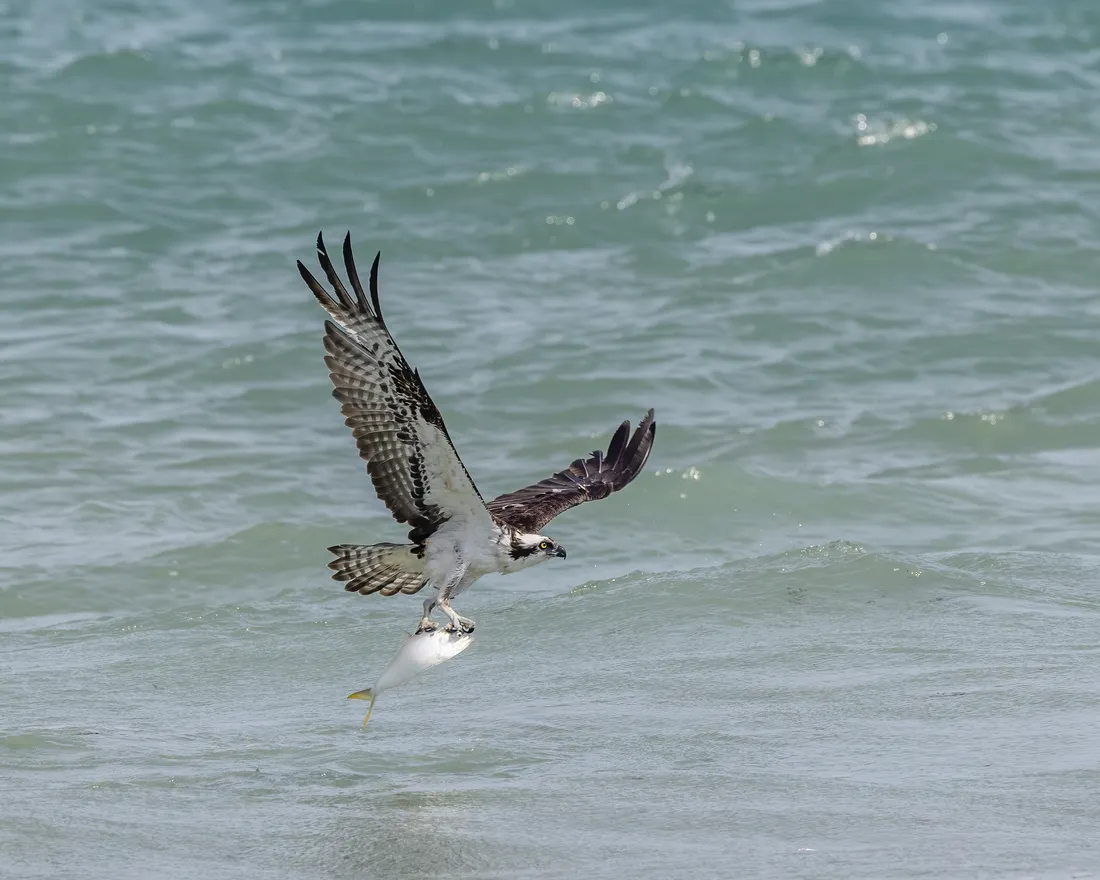

The short answer
An Osprey has a white head with a broad dark eye stripe. From below, look for long wings that bend at the wrist, with a dark patch at each bend. It often hovers over water before diving feet-first for fish.
An Osprey carrying a fish can look like a Bald Eagle at a distance. Wait for the bird to bank and show you the underside of its wings. If it keeps returning to a stick platform, you may get a second chance to watch the approach from shore.
Identify a bird
Free photo or sound ID. No signup.
On this page9 min read
Reported Osprey sightings
Contiguous U.S. · 2020–2024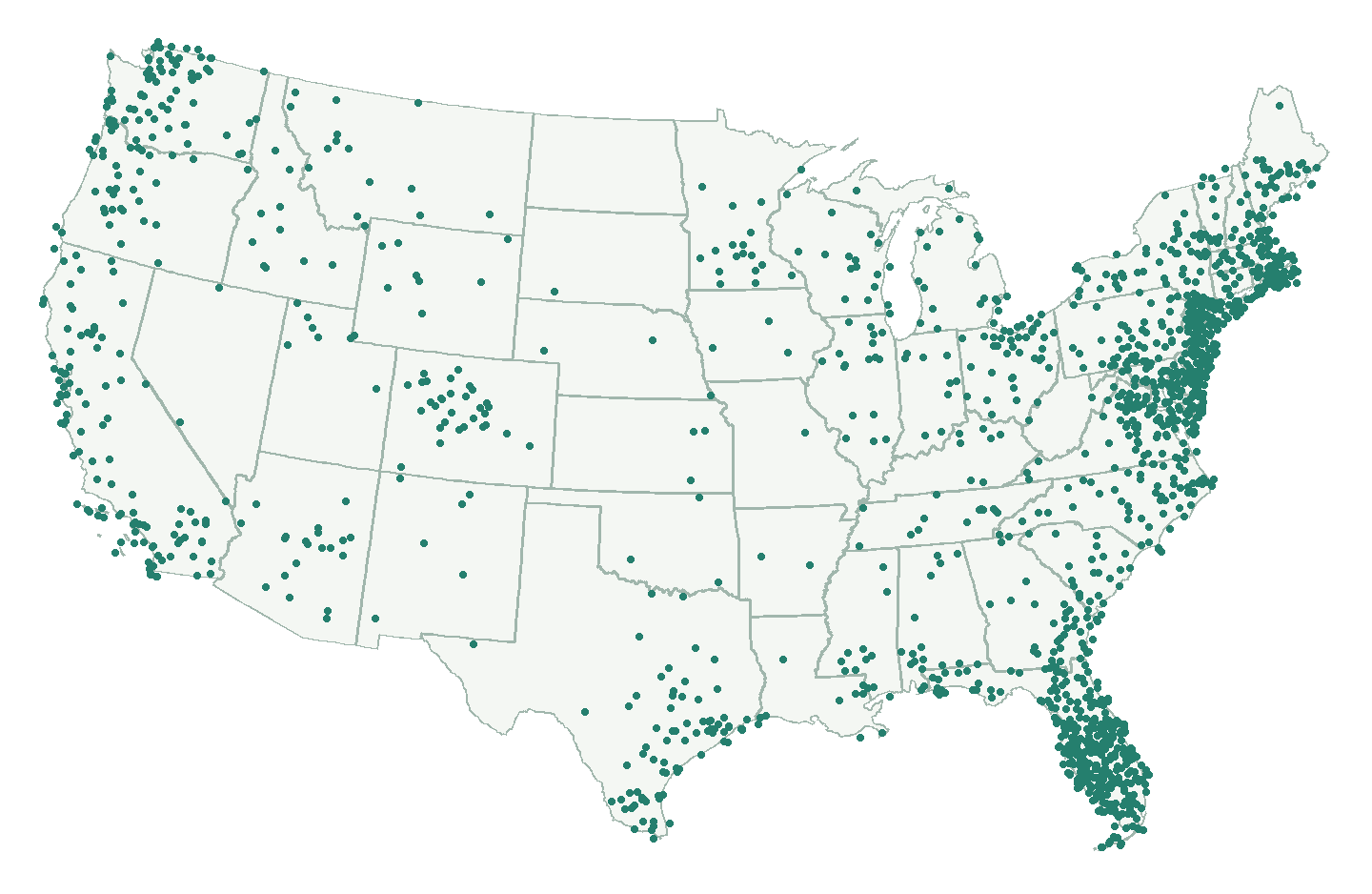
- 0
- <5
- 5–<25
- 25–<75
- 75–<150
- 150+
Reports by month
Show the data table
| Month | Reports | Per 10,000 |
|---|---|---|
| January | ||
| February | ||
| March | ||
| April | ||
| May | ||
| June | ||
| July | ||
| August | ||
| September | ||
| October | ||
| November | ||
| December |
The all-months map spreads dots within 250 km grid cells. The monthly map and chart show the share of all eBird bird reports. This adjusts for differences in the number of reports submitted by place and month. Data from Cornell’s eBird Observation Dataset via GBIF (CC BY 4.0). U.S. Census Bureau state boundaries.
How to identify an Osprey
A perched Osprey has a brown back, pale underparts, and a hooked bill. The dark stripe runs from the eye toward the back of the white head. Adults typically have yellow eyes. Females average heavier than males and often have more brown streaking across the chest, though the markings overlap.
Juveniles can have orange eyes and pale edges on the dark feathers of the back and folded wings. If you’re judging age from a photo, look at those feather edges as well as the eye. Compare juvenile and adult Ospreys side by side.
Find the field marks in flight
Choose a marker to see what to look for.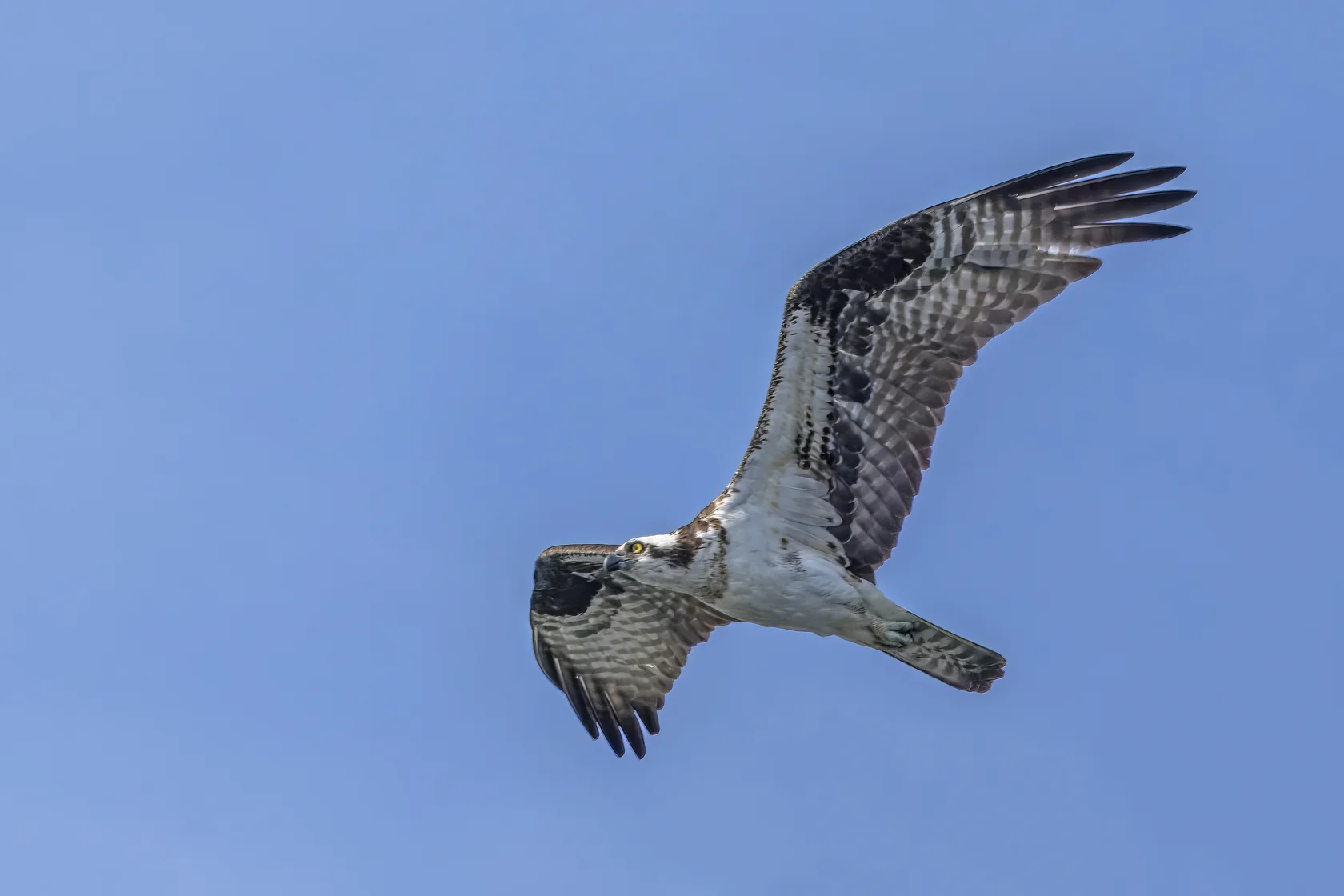
- Dark eye stripe
Follow the dark band behind the eye. It breaks up the white head even when you’re looking up at the bird.
- Dark wrist patch
Look for the dark patch on the leading edge at the wing’s bend. It often stands out from below before the head pattern comes into view.
- Narrow outer wing
Past the bend, the wing tapers toward separated feather tips. A Bald Eagle’s wing looks broader farther out.
Photo by Charles J. Sharp · CC BY-SA 4.0 · resized

Size and wingspan
An Osprey is a large raptor with a comparatively slender body and long wings. A head-on glide can make those wings look like a shallow M.
- Length
- 21–23 in54–58 cm
- Wingspan
- 5–6 ft1.5–1.8 m
- Weight
- 3–4.4 lb1.4–2 kg
Typical ranges for both sexes in Audubon’s field guide.
What does an Osprey sound like?
An Osprey’s high, clear whistles can carry across open water. Look up when the notes are spaced out. A bird passing overhead may chirp a few times as it flies. At a nest, listen for a steady run of whistles that drop in pitch. If another Osprey approaches, the calls can build to a wavering squeal. Compare the Cornell Lab recordings.
Listen and follow the notes
Select a point on the spectrogram to seek.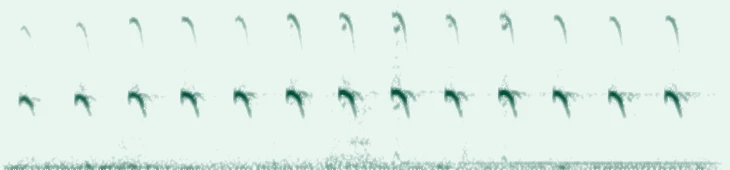
Each dark hook is a note dropping in pitch. The spectrogram uses the same National Park Service field recording you hear in the player. U.S. public domain, converted to MP3. Browse more bird calls.
Watch what happens after the call
In a courtship display, a male may give a louder call as he climbs and dives, sometimes with a fish in his talons. Repeated calls from a bird on the nest can also be a request for food. On Cornell’s Hellgate camera, a fledgling calls before its parent arrives with a fish. If you’re watching a platform and a second bird appears carrying food, you have a clue to what the calling meant. Hear the guard and display calls or watch the fish delivery.
Where and when to see Ospreys in the U.S.
Pick a shoreline where you can see both open water and tall perches. On a reservoir, that may be a turnout overlooking dead trees. On an estuary, try a public path with a view of channel markers and nest platforms. Scan the water for hunting birds, then look up at the perches. An Osprey that’s already caught a fish may spend the next few minutes eating above the water.
New Jersey coast in spring
Ospreys return to the New York and New Jersey area around mid-March. In April, scan the marsh and platforms along Wildlife Drive at Edwin B. Forsythe National Wildlife Refuge. One bird carrying sticks or fish may lead your eye to a platform you missed. National Park Service · Wildlife Drive
Show New Jersey in AprilMinnesota lakes from April
Look along lakes and rivers as open water returns. Lake Bemidji State Park lists Osprey on its checklist. In the 2020–2024 statewide data used above, the share of Osprey reports rose from about 0.5 per 10,000 bird reports in March to 38 in April. That’s a useful starting window when deciding when to go. Minnesota DNR checklist
Show Minnesota in AprilSouth Florida in winter
Some Ospreys stay in southern Florida year-round, and nesting there can begin in December. At Flamingo in Everglades National Park, look from the waterfront for birds traveling between the bay and nest sites. Give any occupied platforms plenty of room. Birding at Flamingo · Florida Fish and Wildlife
Show Florida in JanuaryWhere to watch fall migration
Coasts and river corridors are good places to scan, and migrants can also pass inland along ridges. At Hawk Mountain in Pennsylvania, the long-running raptor count points to mid- to late September as the best window. On a migration watch, expect a bird to keep moving past the lookout. Hawk Mountain’s Osprey count
Diet and fishing
Ospreys eat almost entirely fish, taking whatever suitable prey is near the surface. The menu varies by waterway and can include mullet, flounder, or shad. Watch for a pause in flight before the bird folds its wings and drops feet-first.
Rough pads under the toes help grip slippery prey. The outer toe can turn backward to put two toes on each side of the fish. In flight, an Osprey often carries its catch head-first.
Nesting and breeding
Watch a stick nest for a few minutes. A bird bringing a branch is still building or repairing it. One sitting low may be incubating eggs or sheltering small chicks. When an adult arrives with a fish, watch whether the bird on the nest stands to take the fish or feed the chicks. The rim can hide eggs and young even from a good public viewpoint.
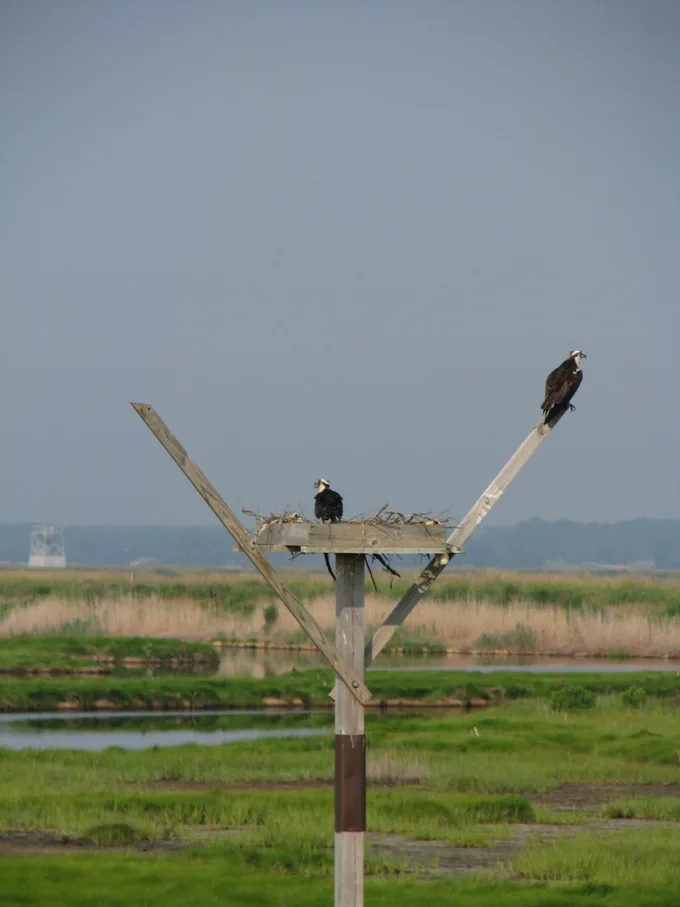
What you might see at the nest
Building and repairs
Pairs choose an exposed site near fishing water, often a tree, pole, channel marker, or platform. They can keep adding sticks to the same nest for years. The male usually brings much of the material.
Incubation · 36–42 days
Ospreys generally raise one brood a year, with one to four eggs. Both adults incubate, and the female does most of the sitting. Watch for a fish handoff when her mate returns.
Chicks · first flight around day 50–55
At first, the female shelters the chicks and feeds them pieces of fish the male brings. As they grow, wing practice becomes visible above the nest rim. First flight is counted from hatching.
After the first flight
Look for fledglings on nearby perches. They can still return to the nest area for fish while learning to hunt.
Typical timing and adult roles from Audubon’s field guide and Hawk Mountain Sanctuary.
At Cornell’s Hellgate nest in Missoula, Montana, a young Osprey named Wensi made its first flight at 55 days. It landed on a nearby pole, close enough for the parents to keep bringing fish. Watch that first flight on the Cornell nest cam archive.
Behavior
Ospreys usually migrate singly and can turn up far from water en route. In breeding areas, a male may climb and dive repeatedly in an aerial display, sometimes carrying a fish or stick. At busy fishing spots, watch the perches as well as the water.
Lifespan and predators
Cornell reports an age of at least 25 years for a banded Virginia Osprey. That is a longevity record. Eggs and chicks are vulnerable at the nest, and Great Horned Owls can take nestlings. A Bald Eagle chasing an adult over water may be after its fish.
Conservation
BirdLife lists the Osprey as Least Concern globally. In North America, populations recovered after restrictions on DDT, which had thinned eggshells. Nest platforms helped where safe nest sites were scarce. Food shortages, contaminants, and hazardous nest sites still matter locally.
Osprey or Bald Eagle?
A fish in the talons is a poor clue by itself. Use the head pattern and silhouette together.
| Feature | Osprey | Bald Eagle |
|---|---|---|
| Head | White with a bold dark eye stripe. | Adults have a plain white head. First-year birds are mostly dark. |
| Wings | Long and bent at the wrist, often with dark wrist patches visible below. | Broader and typically held flatter when soaring. |
| Build | Slender, with a relatively small head. | Heavier body, larger projecting head, and a bigger bill. |
Osprey photos
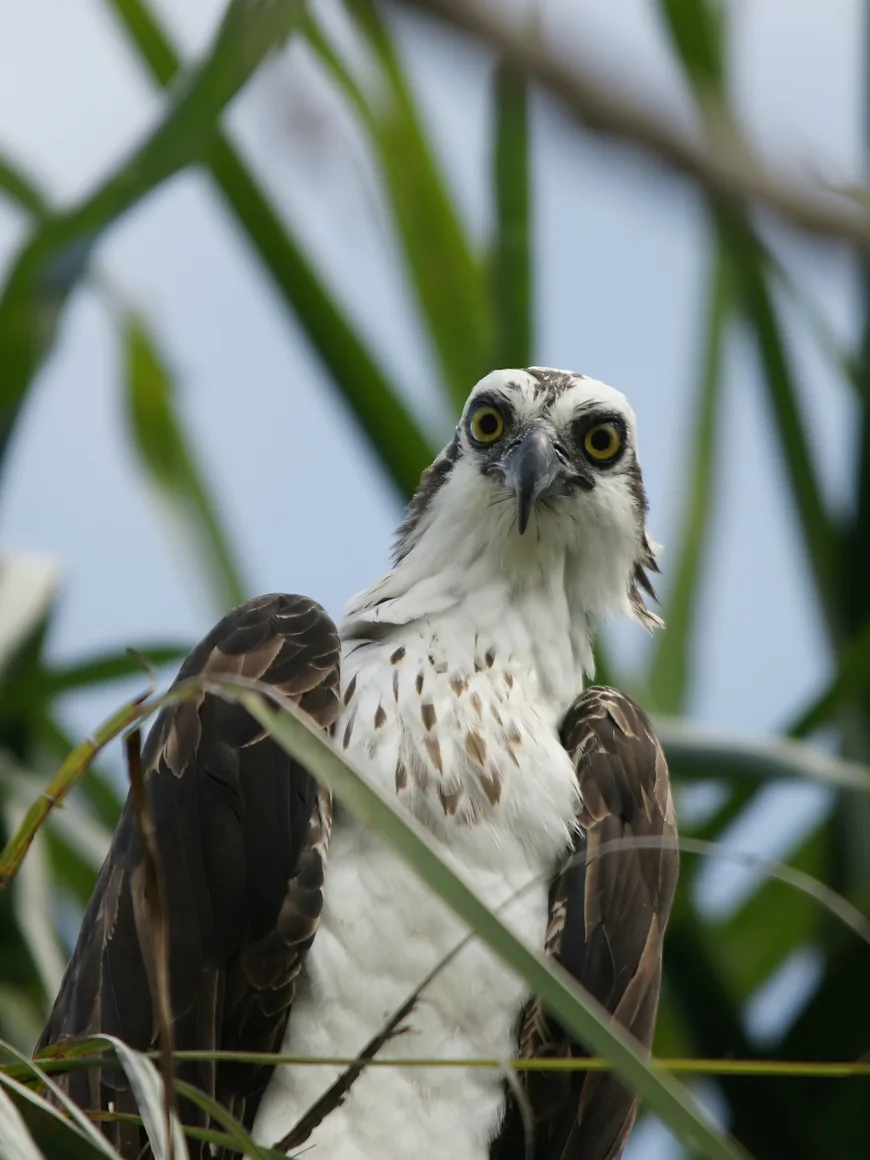
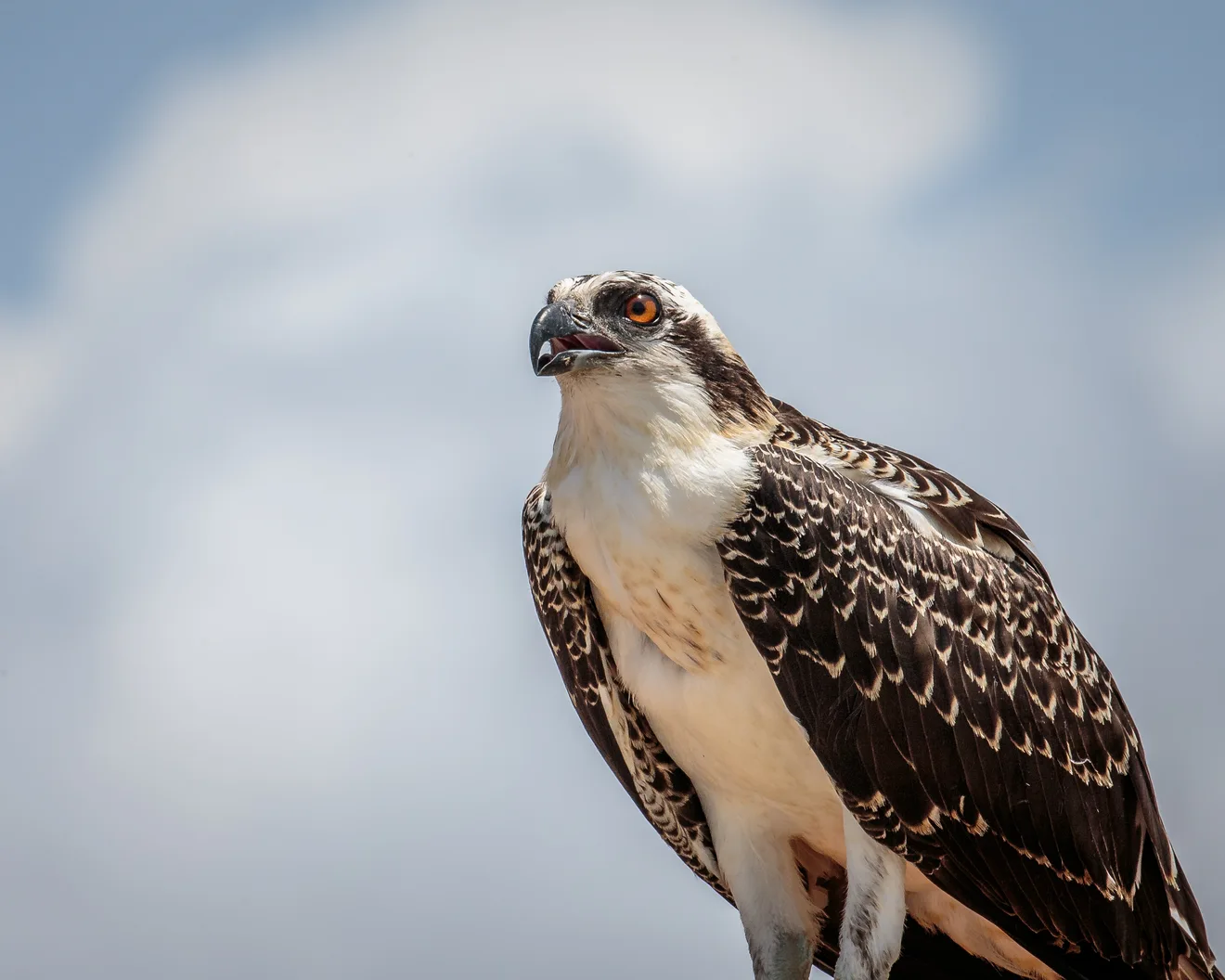
Juvenile Osprey guide
Juvenile Osprey identificationCompare pale feather edges, eye color, and flight marks with adult photos.Osprey quick facts
- Scientific name
- Pandion haliaetus
- Family
- Pandionidae (ospreys)
- Also called
- Fish hawk
- Main food
- Fish
- Eggs per clutch
- 1–4
- Incubation
- 36–42 days
- First flight
- About 50–55 days after hatching
- Documented longevity
- At least 25 years in the wild
- Global conservation status
- Least Concern
- Global population estimate (2021)
- 100,000–1.2 million mature birds
Common questions
Why does an Osprey carry a fish head-first?
Turning the fish head-first reduces drag. An Osprey can shift the catch after takeoff, placing one foot behind the other as it flies to a perch. Hawk Mountain Sanctuary
At what age do Ospreys start breeding?
Ospreys typically first breed at three or four years old. Some return to the breeding grounds before they’re ready to raise young. Hawk Mountain Sanctuary
Do Ospreys use salt water as well as fresh water?
Yes. They fish along coasts, estuaries, and salt marshes, as well as rivers, lakes, and reservoirs. Look for stretches where fish come close enough to the surface for a diving bird to reach. Audubon
Sources and credits
- Audubon for measurements, habitat, migration, diet, and nesting.
- Cornell Lab of Ornithology for identification, sounds, fishing adaptations, and the banding record.
- Indiana Department of Natural Resources for the Bald Eagle comparison.
- Alaska Department of Fish and Game for nest predators.
- BirdLife’s 2021 IUCN assessment for status and estimated population, and the American Bird Conservancy for threats.
The fishing photograph by Andy Morffew is licensed CC BY 2.0 and was resized for this page. See gallery photo credits.