
Mallard
Anas platyrhynchos
Identify a Mallard in breeding or eclipse plumage, hear its quack, and learn where to look for these dabbling ducks in the U.S.

The short answer
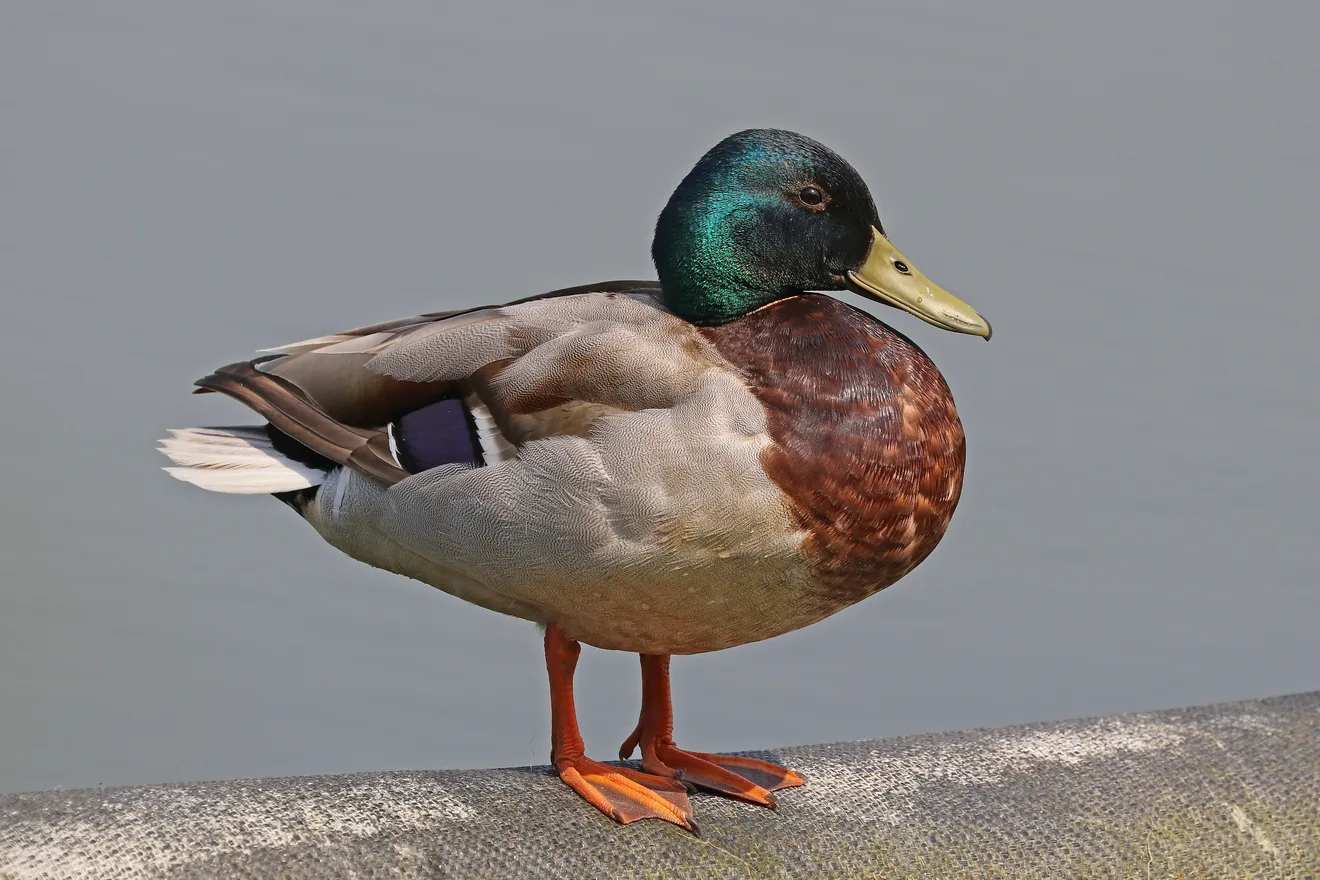
A breeding male Mallard has a green head, yellow bill, white neck ring, and chestnut breast. A female is mottled brown with an orange bill marked in black. Both sexes have a blue-violet wing patch bordered by white, easiest to see in flight.
When a duck tips tail-up in a park pond, watch for it to level out and stretch a wing. That brief view can reveal the wing patch that separates a brown Mallard from several similar ducks.
Identify a bird
Free photo or sound ID. No signup.
On this page8 min read
How to identify a Mallard
For a brown duck, wait for a side view with the bill and folded wing in the same light. An abrupt turn or wing stretch often reveals the blue-violet patch. The patch can look darker or more purple as the bird moves.


Breeding male
The glossy head can look almost black in shade. Look lower for the thin white collar, chestnut chest, and pale gray sides. A side view also shows the curled dark tail feathers on many drakes.
Female
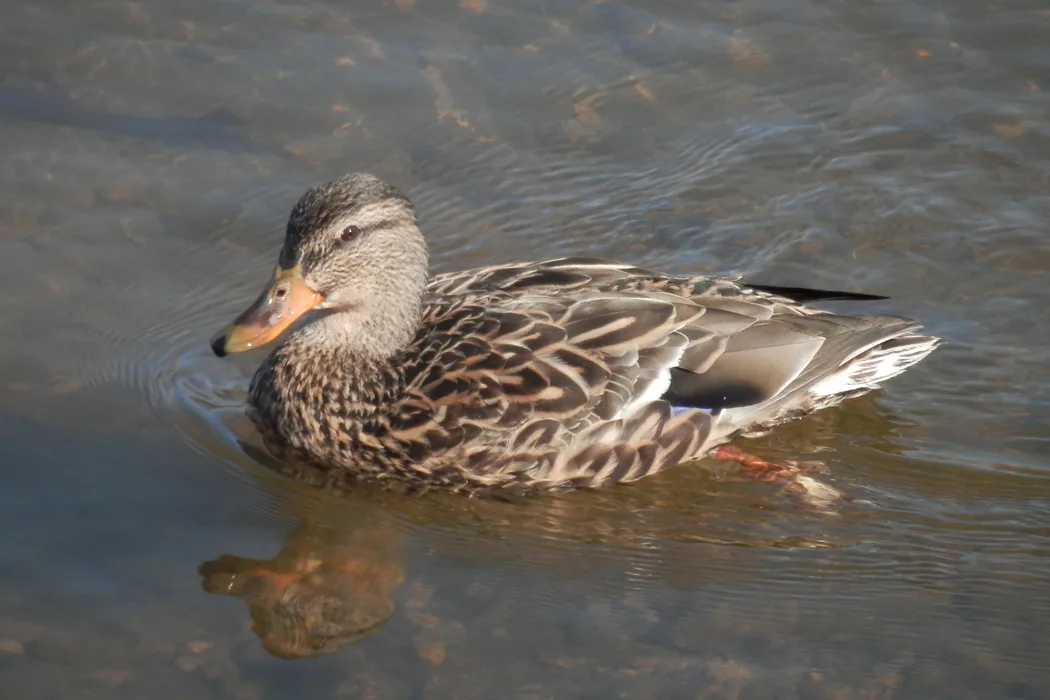
Check the bill in good light. A hen’s bill is usually orange with an irregular dark saddle or blotches, and the body is patterned with brown. Her blue-violet wing patch is easiest to see during a stretch or takeoff.
Eclipse male
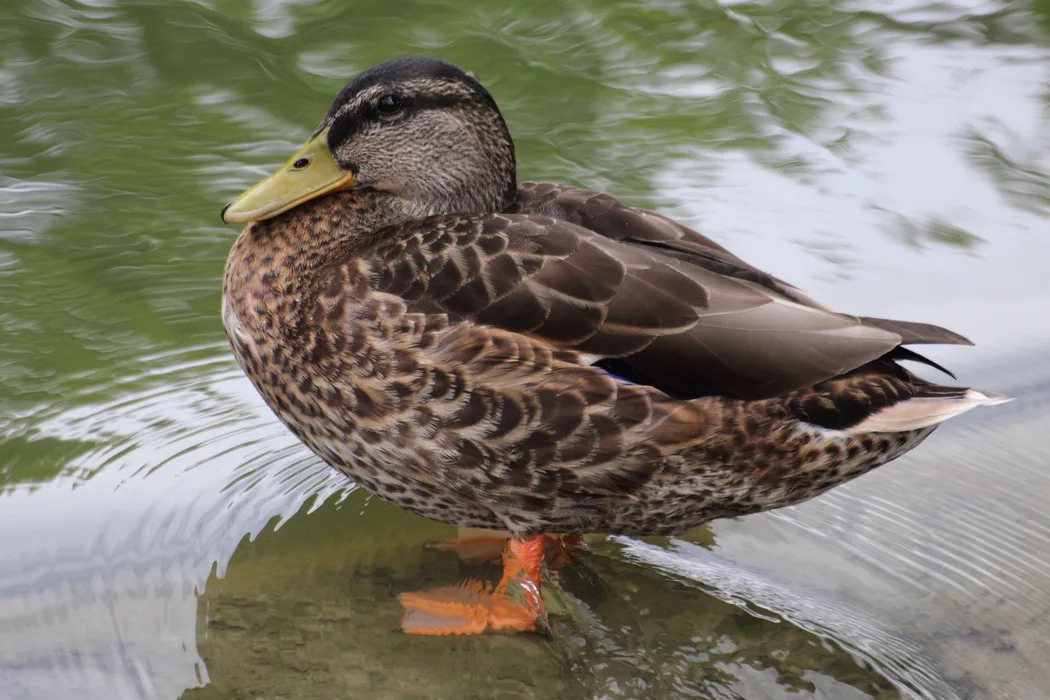
A drake can wear brown body feathers after breeding, so a green head is a poor requirement in summer. Look for the yellower or olive bill, sometimes traces of green on the head, and the same white-bordered wing patch.
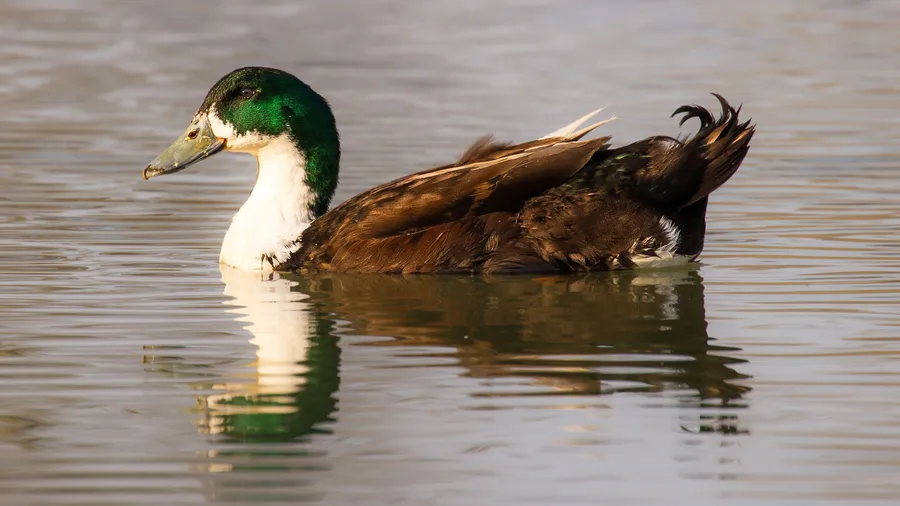
Why does this duck have a white chest?
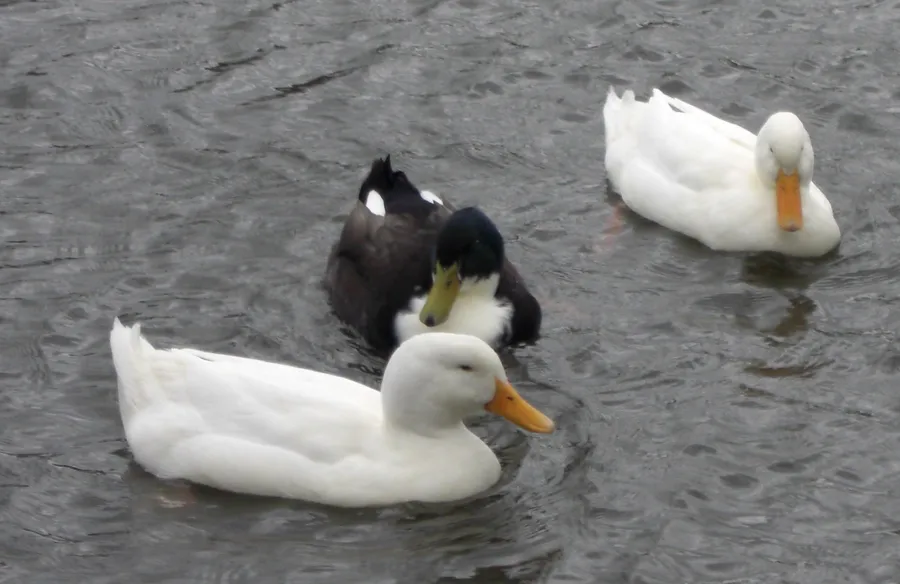
At a park pond, a broad white bib on a duck with a green head and a Mallard-shaped bill is a good clue to domestic ancestry. Compare the first photo with the wild-type drake above. The drake’s thin white neck ring sits above a chestnut breast. On the domestic-looking bird, the white extends down the chest and the body is darker.
Check the whole bird in a side view. Domestic Mallards can be white all over, patchy, or much darker than the wild pattern. Some also look bulkier. A photo can support a domestic-type ID when several of those clues line up. A single white patch leaves more room for doubt, and a photo rarely establishes the breed or parentage. If the chest is all you saw, wait for a clearer look at the head, bill, and body.


Size and wingspan
- Length
- 20–26 in
- Wingspan
- 31–38 in
- Weight
- 2–3.5 lb
Measurements from Audubon’s field guide.
Mallard sounds
The familiar loud, descending string of quacks usually comes from a female. A male’s voice is quieter and raspier. If a group is swimming together, follow the bill movements before matching a call to a bird.
Listen when a female moves between open water and cover near the shore. A short series can carry well across a pond, even if the duck is hidden behind reeds.
Jonathon Jongsma · CC BY-SA 3.0 · Browse more bird calls
What to listen for
Count the beats and listen to their volume. A hen often produces a loud series that trails off. A drake can give just one or two rough notes. If both birds are in view, wait for a repeat and see which opens its bill.
Reported Mallard sightings
Contiguous U.S. · 2020–2024- 0
- <50
- 50–<100
- 100–<180
- 180–<250
- 250+
Reports by month
Show the data table
| Month | Reports | Per 10,000 |
|---|---|---|
| January | ||
| February | ||
| March | ||
| April | ||
| May | ||
| June | ||
| July | ||
| August | ||
| September | ||
| October | ||
| November | ||
| December |
State colors show sightings per 10,000 bird reports, adjusted for differences in reporting by place and month. Use the rates to compare reports across the map. Data from Cornell’s eBird Observation Dataset via GBIF (CC BY 4.0) with U.S. Census Bureau state boundaries. See the species on eBird.
Where and when to look in the U.S.
Check shallow freshwater across the United States. Park ponds, marshes, slow rivers, and flooded fields can all hold Mallards. Look along the edge of open water, where they can reach submerged plants while dabbling.
Mallards stay through winter where conditions allow. Farther north, an open stretch of river can gather ducks from frozen ponds nearby. In spring and summer, scan vegetated margins for hens with ducklings.
Minnesota in May
Walk the edge of a marsh or sheltered lake bay. Scan the reedy shallows first for a hen, then pause to see whether a line of ducklings follows her through gaps in the vegetation.
54,775 reports in 2020–2024, or 223.4 per 10,000 bird reports in that state and month.
Show Minnesota in May on the mapTexas in January
Try a sheltered reservoir arm or a flooded field with shallow water. Scan the edges of a mixed duck flock and wait for a wing stretch before identifying a brown bird at a distance.
17,760 reports in 2020–2024, or 64.6 per 10,000 bird reports in that state and month.
Show Texas in January on the mapWhat does the Mallard eat?
Mallards scoop up aquatic plants, seeds, and small invertebrates. They also feed on land, including in harvested fields. Watch for a bird to paddle slowly with its bill in the water or tip forward over a patch of vegetation.
Watch how it feeds
Give the duck a minute in water shallow enough for plants to grow near the surface. It may sweep the bill side to side, then tip forward to reach lower. A bird that repeatedly disappears underwater to feed is behaving more like a diving duck.
Nesting and breeding
A hen can choose a ground nest well away from water, including in a garden. She lines the bowl with down as laying progresses. If you see a hen entering the same dense patch of vegetation, you can watch her route from a distance.
Once a family moves to water, watch the gaps along the bank. Small ducklings may vanish in the first patch of reeds and reappear around a bend. Give the hen room to lead them through the shallows.
From eggs to young
- Eggs1–13 eggs
The hen selects cover and makes a shallow bowl. A nest may sit beyond the immediate waterline, so a duck walking through a garden can still be nesting nearby.
- Incubation23–30 days
The female incubates the clutch. The nest stays well concealed for much of this period.
- Leaving the nestReady at 13–16 hours old
The ducklings hatch with down and can follow the hen soon afterward. Look along sheltered margins where a brood can move between open water and cover.
Breeding ranges and timing from the Cornell Lab’s life history account.
Behavior
Mallards are dabbling ducks. They usually feed at the surface or upend to reach below it. They often rise straight from the water when they take flight.
During a wing molt, Mallards can temporarily lose the ability to fly. A drake in eclipse can therefore look like a different bird and spend more time near cover. Check the quieter edges if the showy males that were on the main pond in spring seem to have vanished.
How long can a Mallard live?
The longevity record reported by the Cornell Lab is at least 27 years, 7 months. Individual birds often live much shorter lives.
Conservation
Mallards use many kinds of wetlands. Shallow water with vegetated margins offers feeding areas and cover for broods.
Mallard or American Black Duck?
Check the bill and wing together. An American Black Duck looks darker overall and generally lacks the bold white bands on both sides of the blue-violet wing patch. In areas where the two overlap, hybrids can combine features.
| Clue | Mallard | American Black Duck |
|---|---|---|
| Overall color | A female is patterned brown with a lighter face and underparts. | The body is usually dark chocolate-brown with a paler head. |
| Bill | A hen usually shows orange with irregular dark markings. | The bill is often olive on a female and yellow on a male. |
| Wing patch | A blue-violet patch is usually separated from neighboring feathers by white bars. | Usually lacks the two bold white borders. A hybrid may show intermediate markings. |
Mallard quick facts
- Scientific name
- Anas platyrhynchos
- Family
- Anatidae
Common questions
Why is a male Mallard brown in summer?
After breeding, a drake molts into eclipse plumage. His head and body become much duller for a time, while the bill usually remains yellowish.
Which Mallard makes the loud quack?
The familiar loud quack is usually the female’s. A male gives a lower, raspy call.
Sources and credits
- Audubon field guide for field marks, measurements, habitat, diet, and nesting.
- Cornell Lab’s All About Birds species profile for longevity and life history.
- Cornell Lab of Ornithology’s eBird species account for occurrence and species reference material.
- Lead photo by Charles J. Sharp · resized and converted to WebP · CC BY-SA 4.0 · resized.
- Recording by Jonathon Jongsma · CC BY-SA 3.0.