
American Robin
Turdus migratorius
Identify an American Robin by its rusty breast and yellow bill. Listen to its song and learn where it feeds, nests, and spends the winter.

The short answer
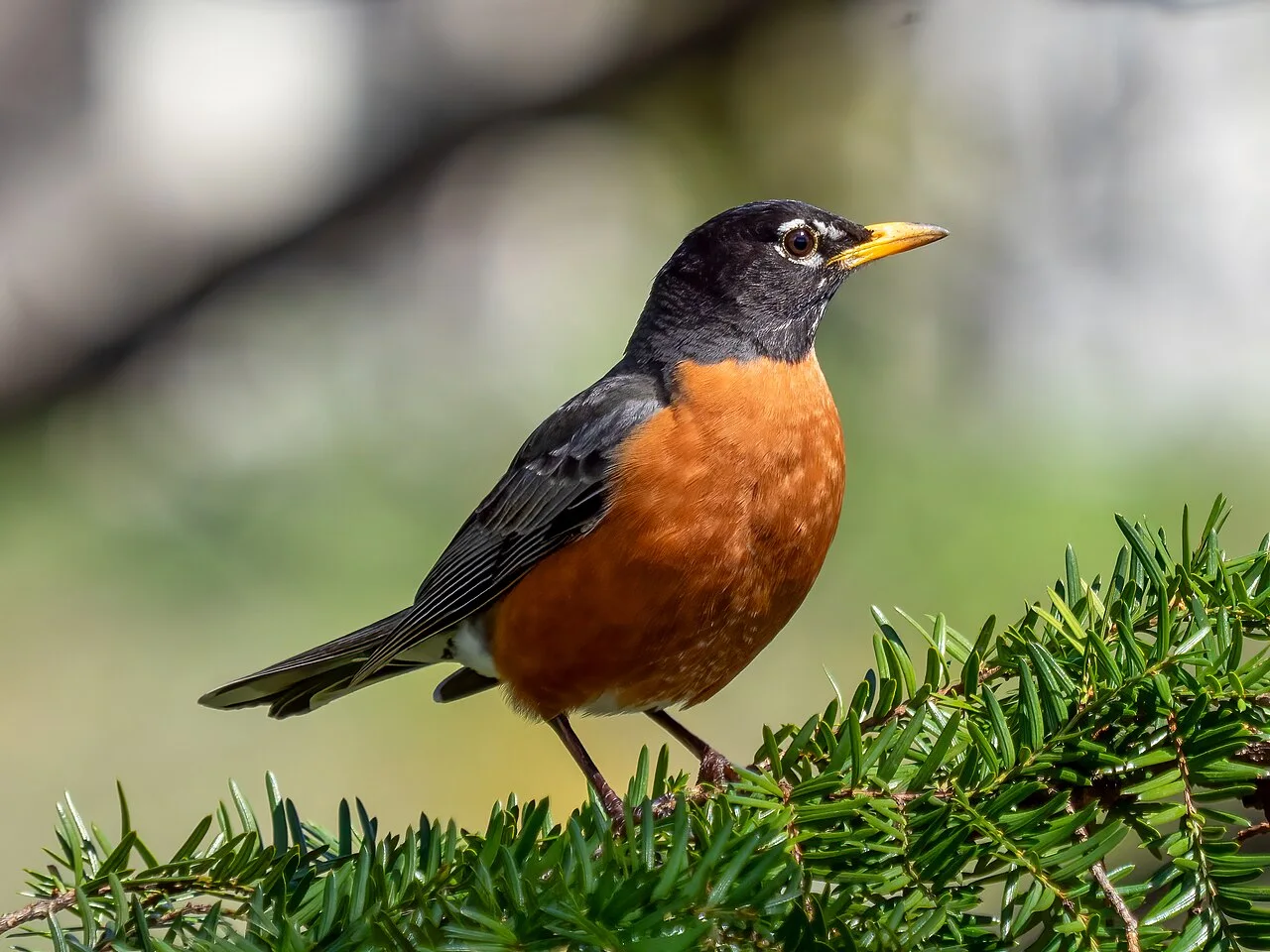
Look for a rusty orange breast, dark gray back, yellow bill, and broken white marks around the eye. On a lawn, an American Robin often runs a few steps, stops upright, then bends to pull food from the ground.
A robin disappears from a bare lawn in winter and turns up in a fruiting tree a block away. That switch in feeding habits helps explain why a bird associated with spring can be present all winter.
Identify a bird
Free photo or sound ID. No signup.
On this page7 min read
How to identify an American Robin
Use shape and color together. A robin has the long legs and upright posture of a thrush. The upperparts are gray-brown and the throat is pale with dark streaks. Males often have darker heads and brighter breasts than females.
Young robins can be confusing. A fledgling has darker spots scattered across its breast, with orange showing between them. The dark-backed thrush shape and an adult bringing food can help confirm the identification.
Find the field marks
Choose a marker to see what to look for.- Broken eye ring
Look for small white arcs around the eye set against a dark head.
- Orange underparts
Rusty color continues down the breast and belly. A side view shows its extent and the darker gray above.
Adult on a lawn
The body is bigger and longer-legged than most birds sharing the lawn. Look for pale curves above and below the eye, then check whether orange continues down the belly. A sideways glance often reveals the eye marking better than a front view.
A spotted young robin
A juvenile’s dark breast spots can disguise the orange. Follow its outline as it stands upright and hops or runs. The large thrush shape, relatively long legs, and yellowish bill help when the plumage alone looks unfamiliar.
A bird in a fruiting tree
Look for dark backs with flashes of rusty color when birds change branches. You may see the head and bill clearly only when one leans out to reach a berry. Adult females can show a softer transition from the gray head to the back.
Size and wingspan
- Length
- 8–11 in
- Wingspan
- 12–16 in
- Weight
- About 3 oz
Measurements from Audubon’s field guide.
American Robin sounds
The song strings short, rounded phrases together. The notes lift and fall, with little spaces between phrases. Listen from a yard or park in the early morning during the breeding season, when a robin may sing from an exposed perch.
Calls are shorter than the song. Sharp notes and agitated scolding can come from a bird watching a disturbance near its nest. Listen for repeated musical phrases before deciding you are hearing the full song.
National Park Service · U.S. public domain · Browse more bird calls
What to listen for
Separate the steady, spaced phrases of the song from short calls by watching for a pause. A bird singing from a treetop may repeat similar phrases for some time. A group moving through berry trees often calls briefly as individual birds shift position.
Reported American Robin sightings
Contiguous U.S. · 2020–2024- 0
- <10
- 10–<50
- 50–<150
- 150–<400
- 400+
Reports by month
Show the data table
| Month | Reports | Per 10,000 |
|---|---|---|
| January | ||
| February | ||
| March | ||
| April | ||
| May | ||
| June | ||
| July | ||
| August | ||
| September | ||
| October | ||
| November | ||
| December |
State colors show sightings per 10,000 bird reports, adjusted for differences in reporting by place and month. Use the rates to compare reports across the map. Data from Cornell’s eBird Observation Dataset via GBIF (CC BY 4.0) with U.S. Census Bureau state boundaries. See the species on eBird.
Where and when to look in the U.S.
Robins breed across much of the United States, from city parks and open woods to mountain forests. In spring, search a lawn with trees nearby. In the arid Southwest, check higher-elevation woodland for breeding birds.
In fall and winter, look for flocks near fruiting trees and shrubs. The winter distribution shifts with food and weather, and some birds stay in northern areas. Choose a state and month in the sightings map to see when robins were reported there.
Minnesota in April
Try a park with open grass next to mature trees. Check the lawn for feeding birds early in the walk, then scan the higher branches for one singing from above the same clearing.
59,507 reports in 2020–2024, or 418.2 per 10,000 bird reports in that state and month.
Show Minnesota in April on the mapTexas in January
Start where accessible fruit remains in winter, such as a park with fruiting shrubs or small trees. Do a slow scan at branch height before judging the empty grass below them.
32,122 reports in 2020–2024, or 116.9 per 10,000 bird reports in that state and month.
Show Texas in January on the mapWhat does the American Robin eat?
On open ground, robins eat earthworms and other invertebrates. As fruit becomes more important, check crabapples or other berry-bearing plants. A winter flock can be concentrated in one productive patch even when neighboring lawns are empty.
Watch the feeding rhythm
On a lawn a robin may run, stop abruptly, and tilt its head before striking. In a tree the same bird moves among fruit clusters. Those two feeding scenes explain why one visit can make robins seem abundant and another can miss them entirely.
Nesting and breeding
A female shapes a cup from grasses and other plant material, reinforces it with mud, and lines it with fine grasses. Look for nests in trees, shrubs, and occasionally on sheltered parts of buildings.
Both parents help feed the young. Fledglings can spend time on the ground or on low branches before they fly well. Watch from a distance for an adult returning with food.
From eggs to young
- Clutch3–5 eggs
A female builds the cup around its mud layer. Apple-blue eggs may be visible in an abandoned nest, but a blue egg by itself is insufficient evidence of species.
- Incubation12–14 days
A still adult sitting low in a cup can be easier to see from the side than from a path directly underneath it.
- Young in the nestAbout 13 days
After leaving the nest, young may wait low in shrubs or on the ground while adults continue feeding them.
Breeding ranges and timing from the Cornell Lab’s life history account.
Behavior
Robins can congregate in large flocks outside the breeding season. In spring, the same neighborhood may hold scattered pairs defending nesting areas. The seasonal change is a useful clue when several orange-breasted birds turn up together.
The switch from scattered breeding territories to winter flocks changes where you look and what you hear. One bird singing above a lawn is a good spring clue. A moving cluster of larger thrushes around fruit can be the better winter clue.
How long can an American Robin live?
The longevity record reported by the Cornell Lab is 13 years, 11 months. Individual birds often live much shorter lives.
Conservation
Cornell notes that a bird feeding on lawns can be exposed to lawn treatments. Berries from unsprayed, fruiting shrubs are an important winter food.
American Robin or Eastern Bluebird?
Check the back and belly. An Eastern Bluebird has blue on the wings and tail and a pale belly below its rusty chest. An American Robin is larger, usually with a darker gray back and orange extending farther down the underside.
| Clue | American Robin | Eastern Bluebird |
|---|---|---|
| Back | Dark gray or gray-brown. | Blue wings and tail, especially clear on a male. |
| Below the chest | Rust usually extends farther down the underside. | A pale belly sets off the rusty chest. |
| Posture | Long-legged and often upright while feeding on a lawn. | Smaller bird often hunting from a wire or low perch. |
American Robin quick facts
- Scientific name
- Turdus migratorius
- Family
- Turdidae
Common questions
Do American Robins always migrate south?
Some migrate, while others winter farther north where there is enough fruit. A robin that appears in spring may have spent the winter nearby.
Is an American Robin the same species as a European Robin?
They are different birds. The American Robin is a North American thrush. The European Robin is smaller and has orange on the face as well as the chest.
Sources and credits
- Audubon field guide for field marks, measurements, habitat, diet, and nesting.
- Cornell Lab’s All About Birds species profile for longevity and life history.
- Cornell Lab of Ornithology’s eBird species account for occurrence and species reference material.
- Lead photo by Rhododendrites · CC BY-SA 4.0 · resized.
- Recording by National Park Service · U.S. public domain.