

Mourning Dove
Zenaida macroura
Identify a Mourning Dove by its pointed tail and spotted wings, listen to its coo, and learn where to find it across the U.S.

The short answer
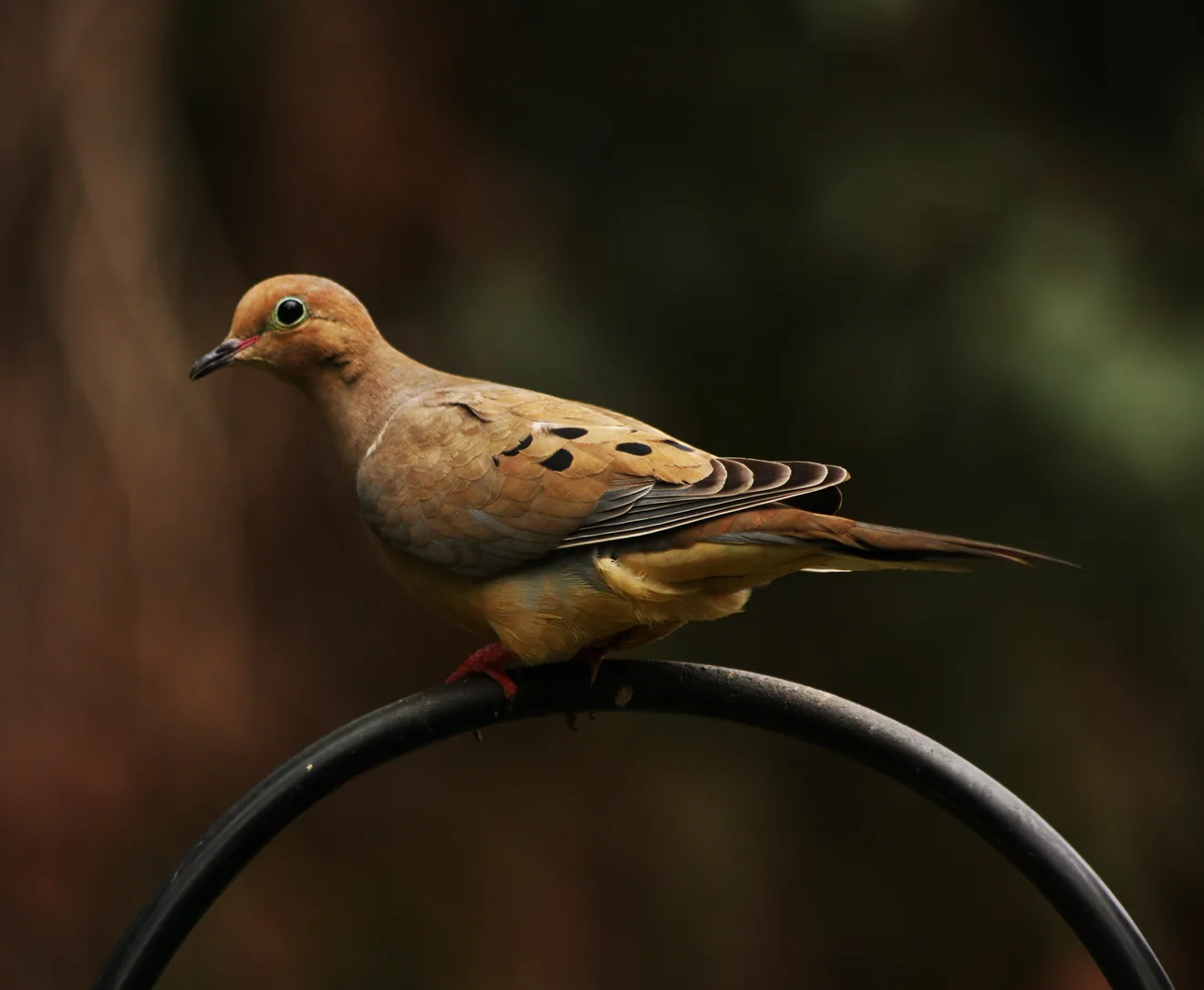
A Mourning Dove is a slender, gray-brown dove with a small head, black spots on its folded wings, and a long pointed tail. When it flies, look for white along the outer tail and listen for a brief wing whistle.
An owl-like coo on a sunny morning can come from a dove on a power line. Check the wires and roof peaks before searching deep in the trees.
Identify a bird
Free photo or sound ID. No signup.
On this page7 min read
How to identify a Mourning Dove
If the bird is on the ground, look for the pointed tail behind a plump body and short legs. A few dark dots across the folded wing stand out against otherwise soft gray and warm brown.
Young Mourning Doves can have pale feather edges that make their plumage look scaly. Check the body size and tail, especially in the Southwest, where smaller ground doves also show a scaly pattern.
Find the field marks
Choose a marker to see what to look for.- Wing spots
Black dots sit on the folded wing, distinct from the otherwise softly colored body.
- Tapered tail
The tail extends behind the perch and narrows to a point. This shape can stay visible after a bird turns away.
Perched on a wire
The head looks small for the body and the tail makes a long point below the feet. A bird facing away can still show dark dots on the wing and a narrower outline than a stocky city pigeon.
Scaly feathers on a young bird
Look at the overall size and tail before naming a juvenile from the scaly texture. The pattern is caused by pale feather edges. A small ground dove can be similar at a glance, especially before the Mourning Dove’s tail looks fully grown.
A quick flush from the ground
Look for the tail spread as the bird banks. White at the outer edges and a pointed central shape can be easier to see than its back. The wing whistle gives you a second clue when the view is brief.
Size and wingspan
- Length
- 9–13 in
- Wingspan
- 17 in
- Weight
- 3–6 oz
Measurements from Audubon’s field guide.
Mourning Dove sounds
The low, soft coo often has a slightly rising opening followed by lower, evenly spaced notes. A male may sing repeatedly from a roof, wire, or open branch. The rounded tone is easy to mistake for an owl at a distance.
A dove that flushes from the ground often makes a high whistle on the first wingbeats. The sound is produced by its wings and is a different clue from the coo you hear when it sits.
Jonathon Jongsma · converted to MP3 · CC BY-SA 3.0 · Browse more bird calls
What to listen for
Listen for the pattern more than the tone. The coo typically opens with a longer phrase, then settles into spaced, low notes from the same place. A sharp whistle during takeoff can come from the same dove even though it sounds entirely different.
Reported Mourning Dove sightings
Contiguous U.S. · 2020–2024- 0
- <120
- 120–<200
- 200–<270
- 270–<350
- 350+
Reports by month
Show the data table
| Month | Reports | Per 10,000 |
|---|---|---|
| January | ||
| February | ||
| March | ||
| April | ||
| May | ||
| June | ||
| July | ||
| August | ||
| September | ||
| October | ||
| November | ||
| December |
State colors show sightings per 10,000 bird reports, adjusted for differences in reporting by place and month. Use the rates to compare reports across the map. Data from Cornell’s eBird Observation Dataset via GBIF (CC BY 4.0) with U.S. Census Bureau state boundaries. See the species on eBird.
Where and when to look in the U.S.
Look in open country with scattered trees across much of the United States. Farm edges, cemeteries, suburban streets, and gaps beside a stand of trees are good places to start. Scan low wires and bare patches of ground.
Many stay year-round in the southern U.S. and some move south from northern breeding areas. A winter visit can turn up a group feeding together, while in spring a single bird cooing from a regular perch is easier to locate by ear.
Arizona in April
Check a low wire near open ground and shrubs. In spring, wait for a clear side view and compare the wing and tail with any White-winged Doves that share the same street.
63,171 reports in 2020–2024, or 313.1 per 10,000 bird reports in that state and month.
Show Arizona in April on the mapIllinois in July
Watch short grass and field edges beside scattered trees. When doves rise from bare soil, follow the tail shape against an uncluttered background and note where they land.
33,594 reports in 2020–2024, or 326.6 per 10,000 bird reports in that state and month.
Show Illinois in July on the mapWhat does the Mourning Dove eat?
Mourning Doves pick up seeds from bare ground and short vegetation. Look beneath seed feeders and along the edges of paths or fields, where the birds can walk and peck without moving through tall plants.
Scan below the feeder
Look on the ground nearby, especially where seeds have fallen into open patches. A dove can spend a long time walking and pecking with only short trips to a perch. You may hear it only once the feeding group is disturbed.
Nesting and breeding
The nest is a shallow platform of small sticks, often in a tree or shrub. The male brings material and the female arranges it. Doves also use sheltered ledges and may nest several times in a season.
Both parents feed the nestlings. If you spot the platform in a garden or on a porch, observe from a place where the adults can come and go freely.
From eggs to young
- ClutchUsually 2 eggs
A dove’s thin platform can look unfinished. Gaps between sticks are normal and do not tell you whether the structure has been abandoned.
- IncubationAbout 14 days
Both adults can incubate. A bird remaining motionless in a shallow nest can stay almost invisible among the branches.
- Young in the nest12–15 days
The young leave quickly compared with many larger birds. Adult doves can still feed them after they move to nearby cover.
Breeding ranges and timing from the Cornell Lab’s life history account.
Behavior
A feeding bird usually walks with quick steps and short pauses. When disturbed it takes off abruptly and can move fast across open space on pointed wings.
A pair can return to the same yard through multiple nesting attempts. Observe the birds’ routine from a window or existing path. The small twig platform and frequent visits are more informative than one fleeting glance into it.
How long can a Mourning Dove live?
The longevity record reported by the Cornell Lab is at least 30 years, 4 months. Individual birds often live much shorter lives.
Conservation
The Mourning Dove remains widespread. Open feeding ground near suitable nesting trees helps explain why it persists in many agricultural and suburban landscapes.
Mourning Dove or Eurasian Collared-Dove?
The collared-dove is paler and stockier, with a black band across the back of the neck and a squared tail. The Mourning Dove has conspicuous wing spots and a tail that tapers to a point.
| Clue | Mourning Dove | Eurasian Collared-Dove |
|---|---|---|
| Tail | Long and pointed, with white visible at the outside. | Broader tail with a squared end. |
| Neck | Lacks the bold black collar across the nape. | Adult typically has a narrow black half-collar. |
| Wing | Black spots on the folded wing. | Generally plainer folded wing and a bulkier shape. |
Mourning Dove quick facts
- Scientific name
- Zenaida macroura
- Family
- Columbidae
Common questions
Is the Mourning Dove the bird that sounds like an owl?
Its low coo is a common source of that confusion, especially in daylight in towns and yards. Scan exposed perches for a small-headed dove.
What makes the whistle when a Mourning Dove takes off?
The bird’s wings produce the high whistle, most noticeably in the first fast strokes after takeoff.
Sources and credits
- Audubon field guide for field marks, measurements, habitat, diet, and nesting.
- Cornell Lab’s All About Birds species profile for longevity and life history.
- Cornell Lab of Ornithology’s eBird species account for occurrence and species reference material.
- Lead photo by Thomas · resized and converted to WebP · CC BY 2.0 · resized.
- Recording by Jonathon Jongsma · converted to MP3 · CC BY-SA 3.0.