

Black-capped Chickadee
Poecile atricapillus
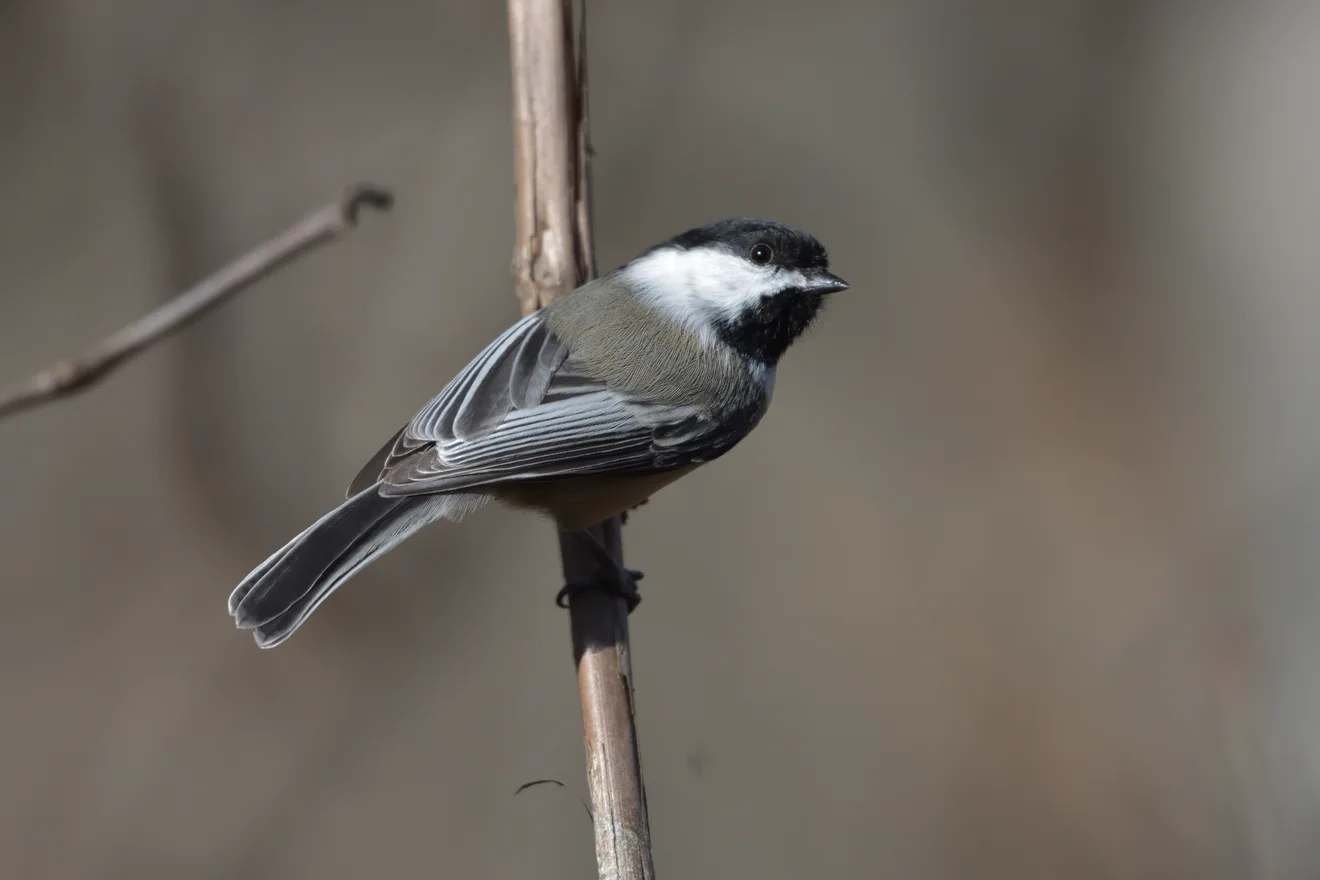
Identify a Black-capped Chickadee by its white cheeks and black cap. Hear it call and compare it with the Carolina Chickadee.

The short answer
A Black-capped Chickadee is a small, round-headed bird with a black cap and bib, white cheeks, and a gray back. Pale edges on the wing feathers can help separate it from a Carolina Chickadee, especially when you also know the location.
At a feeder a chickadee may stay just long enough to grab a seed. Follow it into the branches for a clearer view of the pale cheek and dark bib.
Identify a bird
Free photo or sound ID. No signup.
On this page7 min read
How to identify a Black-capped Chickadee
Look for a large round head on a small body, a short bill, and a narrow tail. The white cheek is sandwiched between the black crown and throat. The wings and back look gray, and the sides can have a buff wash.
A bird working thin outer branches may hang sideways or upside down. Wait for it to turn so you can see the wing edges. In the contact zone with Carolina Chickadees, appearance alone can leave the identification uncertain.
Find the field marks
Choose a marker to see what to look for.- White cheek
The bright cheek separates the dark cap from the small black bib below.
- Pale feather edges
Fine pale lines run along several folded wing feathers. Their contrast varies with wear and lighting.
A chickadee facing away
A rear view hides the bib. Look for a head that seems large for the body, a narrow tail, and a pale-edged wing. Then wait for a turn that lets you see the white cheek and where it meets the back of the head.
At the Black-capped and Carolina boundary
Compare several views if you can. Pale wing edging, contrast around the cheek, and the outline of the bib are more useful together. Worn feathers, light, and overlap between the species can make any single mark misleading.
A pale bird traveling with a chickadee flock
Mixed flocks can include nuthatches and other small birds. Watch one individual stay in view through a few movements. A chickadee’s short bill and bib are most useful after it leaves a trunk and hangs from a fine twig.
Size and wingspan
- Length
- 5–6 in
- Wingspan
- 6–8 in
- Weight
- 0.3–0.5 oz
Measurements from Audubon’s field guide.
Black-capped Chickadee sounds
The familiar chick-a-dee call can end with several repeated notes. Chickadees use it to keep in contact and when alarmed, so the number and pace of notes can vary.
The song in much of the eastern range is a clear two-note whistle, usually with the second pitch lower. Whistle patterns vary by region and can overlap with Carolina Chickadee where the two meet.
Jonathon Jongsma · CC BY-SA 3.0 · Browse more bird calls
What to listen for
Use the whistle to locate the bird and the full call to listen for contact between flock members. If the sound gets abrupt and multiple birds gather in the same place, watch for their reaction before assigning the call to one species from pitch alone.
Reported Black-capped Chickadee sightings
Contiguous U.S. · 2020–2024- 0
- <10
- 10–<60
- 60–<180
- 180–<350
- 350+
Reports by month
Show the data table
| Month | Reports | Per 10,000 |
|---|---|---|
| January | ||
| February | ||
| March | ||
| April | ||
| May | ||
| June | ||
| July | ||
| August | ||
| September | ||
| October | ||
| November | ||
| December |
State colors show sightings per 10,000 bird reports, adjusted for differences in reporting by place and month. Use the rates to compare reports across the map. Data from Cornell’s eBird Observation Dataset via GBIF (CC BY 4.0) with U.S. Census Bureau state boundaries. See the species on eBird.
Where and when to look in the U.S.
Try wooded parks, yards with mature trees, and mixed woods in the northern United States. Farther west, look in suitable woodland rather than assuming that any bird with a dark cap is this species.
Many Black-capped Chickadees stay year-round. In winter, listen for a small flock moving through bare branches, sometimes with nuthatches and other birds. In spring, the clear whistle can give away a bird before you see it.
Maine in January
Work along a wooded edge with accessible low branches. Pause where a small flock crosses an opening, then watch the branches on the far side for a bird that stops to open a seed.
20,475 reports in 2020–2024, or 657.4 per 10,000 bird reports in that state and month.
Show Maine in January on the mapMinnesota in May
Try a quiet deciduous or mixed woodland path in spring. A whistle may come from above eye level. Stop under an opening and scan opposite branches where the singer has space to perch.
62,470 reports in 2020–2024, or 254.7 per 10,000 bird reports in that state and month.
Show Minnesota in May on the mapWhat does the Black-capped Chickadee eat?
Black-capped Chickadees search leaves, bark, and twigs for insects and spiders. They also eat seeds, especially during colder months. A feeder visitor often carries a seed away to open it on a branch or store it.
Follow a seed after it leaves the feeder
A chickadee often flies to a branch with a single seed. It may pin the seed with its toes and hammer it open. If the bird tucks the seed behind bark and leaves, you may have watched it store food for later.
Nesting and breeding
Pairs can excavate a cavity in soft, decaying wood or use an existing hole or nest box. The female adds a lining of soft material such as moss and animal fur.
A bird flying repeatedly to one small opening may be bringing food to the nest. It is usually possible to watch this from the trail without standing close to the cavity.
From eggs to young
- Clutch1–13 eggs
A cavity can be in a snag, broken limb, or nest box. A small pile of fresh chips may suggest excavation but can come from several species.
- Incubation12–13 days
The nest chamber stays hidden, and visits alone rarely reveal whether eggs have hatched.
- Young in the cavity12–16 days
Repeated arrivals with food give a better clue that the young have hatched. Time those trips from a distance if you want to watch the activity.
Breeding ranges and timing from the Cornell Lab’s life history account.
Behavior
In winter, Black-capped Chickadees travel in flocks and store individual food items in separate places. At a feeder, taking one seed and disappearing into cover is typical.
Follow the flock rather than trying to hold one chickadee in view the whole time. It may lead you past a succession of feeding spots, where pauses offer better views than the first flight over the path.
How long can a Black-capped Chickadee live?
The longevity record reported by the Cornell Lab is at least 11 years, 8 months. Individual birds often live much shorter lives.
Conservation
Standing dead wood and older trees can provide nest cavities, while wooded yards and edges provide places to forage.
Black-capped Chickadee or Carolina Chickadee?
The species look very similar. Black-capped usually shows stronger pale edging in the wings and a more ragged lower edge to the bib. Start with location and use more than one clue where the ranges meet.
| Clue | Black-capped Chickadee | Carolina Chickadee |
|---|---|---|
| Wing | Often shows stronger pale bordering on the folded wing. | The folded wing generally has subtler pale edging. |
| Bib | The lower edge can look irregular against the breast. | The lower margin often appears more sharply defined. |
| Where to start | Check the expected local range, especially farther north. | Check southern range and treat contact-zone birds with care. |
Black-capped Chickadee quick facts
- Scientific name
- Poecile atricapillus
- Family
- Paridae
Common questions
Do Black-capped Chickadees go south in winter?
Most stay in their usual range year-round, although movements vary. Winter flocks often visit the same wooded spots and feeders repeatedly.
What is the chickadee’s two-note whistle?
It is the song most familiar in the eastern part of its range. The first note is usually higher than the second.
Sources and credits
- Audubon field guide for field marks, measurements, habitat, diet, and nesting.
- Cornell Lab’s All About Birds species profile for longevity and life history.
- Cornell Lab of Ornithology’s eBird species account for occurrence and species reference material.
- Lead photo by John Stockla · resized and converted to WebP · CC BY-SA 4.0 · resized.
- Recording by Jonathon Jongsma · CC BY-SA 3.0.