

Northern Cardinal
Cardinalis cardinalis
Identify male, female, and young Northern Cardinals. Listen to a reference recording and find out where this year-round resident feeds and nests.

The short answer
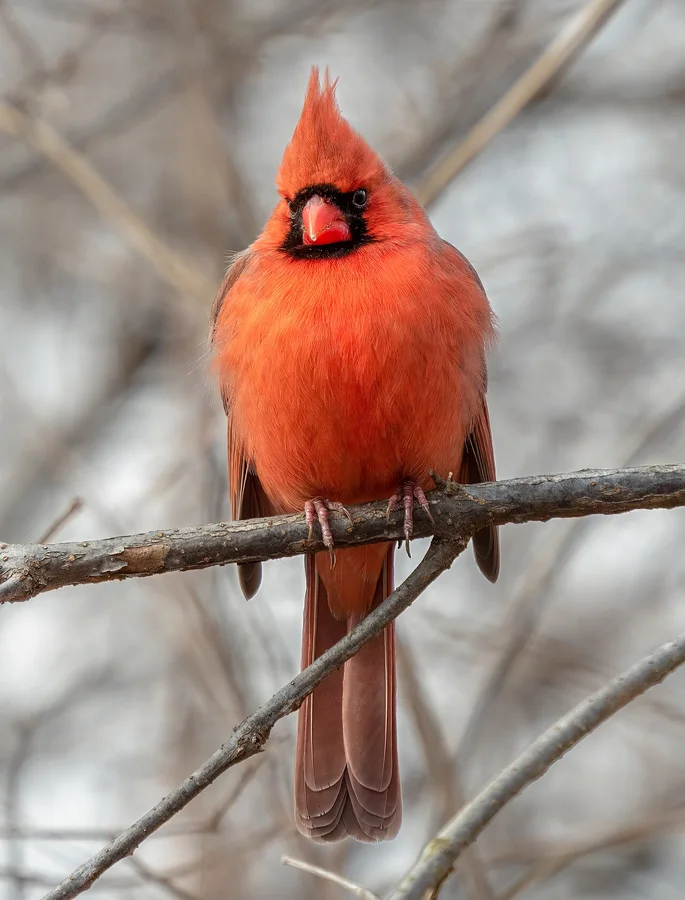
Look for a pointed crest, heavy cone-shaped bill, and long tail. Male Northern Cardinals are red with a black face. Females are buff-brown with reddish wings and tail and usually a reddish-orange bill.
A brown bird beside a bright red cardinal often belongs to the same species. The crest and thick bill tell you more than the amount of red, especially when you are looking at a female or a recently fledged bird.
Identify a bird
Free photo or sound ID. No signup.
On this page7 min read
How to identify a Northern Cardinal
An adult male often appears red from crest to tail. The edge of the black face can look sharp even from across a yard. A female is more subdued, with red on the wings, tail, and parts of the crest. Both have the same upright crest and bulky bill.
A young cardinal can have a dark bill. Compare its shape before using bill color to rule it out. A red bird without a crest could be a tanager, while a smaller streaky bird at a feeder may be a House Finch.
Find the field marks
Choose a marker to see what to look for.- Crest
The pointed crest rises over the head. A female has the same basic head shape with subtler color.
- Heavy bill
A thick, triangular bill sits inside the black face mask of an adult male.
Scarlet male
The dark mask surrounds a heavy colored bill. In shade the body can look deep brick red, but the crest, long tail, and thick bill keep the silhouette distinctive. Look for the bird’s outline before trying to judge the shade of red.
Female with red accents
A female can look tan at first. Look for red in the wings, tail, or crest, and a red-orange bill. Watching the lower branches of a shrub gives you a longer view than waiting for the bird to emerge into full sun.
Young bird with a dark bill
An immature bird can resemble a female while still showing a dusky bill. Use the crest and long tail along with reddish wing or tail feathers. A single mark is often hardest to read just after the bird fledges.
Size and wingspan
- Length
- 8–9 in
- Wingspan
- 9–12 in
- Weight
- 1.5–1.7 oz
Measurements from Audubon’s field guide.
Northern Cardinal sounds
Cardinal song often starts with clear whistles and ends in a repeated phrase. Listen for the order and rhythm of the notes. Songs can vary, even within a neighborhood.
Both sexes sing. A short metallic chip is common around shrubs and feeders and may be heard while a bird is still in cover. Wait for a longer whistle sequence if you want to distinguish a song from a contact call.
Jonathon Jongsma · converted to mono WAV · CC BY-SA 3.0 · Browse more bird calls
What to listen for
A loud clear whistle may be a song from either sex. Wait for a phrase to repeat and look for the bird changing posture on a branch. Short sharp chips from within the shrub can continue even after the clearer song stops.
Reported Northern Cardinal sightings
Contiguous U.S. · 2020–2024- 0
- <10
- 10–<50
- 50–<200
- 200–<500
- 500+
Reports by month
Show the data table
| Month | Reports | Per 10,000 |
|---|---|---|
| January | ||
| February | ||
| March | ||
| April | ||
| May | ||
| June | ||
| July | ||
| August | ||
| September | ||
| October | ||
| November | ||
| December |
State colors show sightings per 10,000 bird reports, adjusted for differences in reporting by place and month. Use the rates to compare reports across the map. Data from Cornell’s eBird Observation Dataset via GBIF (CC BY 4.0) with U.S. Census Bureau state boundaries. See the species on eBird.
Where and when to look in the U.S.
Northern Cardinals are year-round residents across much of the eastern U.S. and parts of the Southwest. Look in thickets, brushy woodland edges, parks, and gardens. In the Southwest, search streamside brush or washes with tall shrubs.
During the breeding season, check exposed perches near thick cover for a singer. In winter, watch low branches and the ground beneath shrubs. A pair or small group may make short trips between shelter and a feeding spot.
Ohio in May
Try a brushy park edge with a few taller perches above the shrubs. Listen early in the day and scan the end of each exposed branch once a whistle repeats.
138,303 reports in 2020–2024, or 277 per 10,000 bird reports in that state and month.
Show Ohio in May on the mapArizona in March
Look in denser patches of vegetation along washes or in gardens within its range. In an area with Pyrrhuloxia, keep watching until the bill color and shape resolve in good light.
24,767 reports in 2020–2024, or 150.8 per 10,000 bird reports in that state and month.
Show Arizona in March on the mapWhat does the Northern Cardinal eat?
The thick bill cracks many seeds. Cardinals also eat fruit and insects, and adults feed their young insects. At a feeder, look below the tray as well as on it. Cardinals often pick up fallen seed.
Where to look around a feeder
Check low perches and the ground as well as the feeder itself. Cardinals can slip between a shrub and spilled seeds repeatedly. A long tail and heavy bill can identify a bird even when its body stays partly hidden.
Nesting and breeding
The female builds an open cup in dense vegetation, using twigs and a softer lining. The hidden site may be relatively low in a shrub, vine tangle, or small tree.
A male can bring food while a female is incubating, and both parents feed young. If you notice repeated deliveries to the same bush, watch from far enough away for the routine to continue.
From eggs to young
- Clutch2–5 eggs
The female builds a cup in dense cover. A shrub can hide almost the entire nest, even when adults use the same entrance.
- Incubation11–13 days
If an adult keeps returning to one part of a shrub, observe it from an existing route. It is difficult to infer the nest stage from a single visit.
- Young in the nest7–13 days
Once the young leave, watch for begging and adults carrying food lower in the cover.
Breeding ranges and timing from the Cornell Lab’s life history account.
Behavior
Cardinals often move between low cover and open feeding spots. You may hear a chip deep in the bush before the bird steps out. In winter, more than one can feed near the same patch without announcing itself with song.
Cardinals can sing from a higher, exposed perch and then drop back into cover. When two birds call back and forth, follow each voice from the same spot. Both can be cardinals even if one is much less brightly colored.
How long can a Northern Cardinal live?
The longevity record reported by the Cornell Lab is 15 years, 9 months. Individual birds often live much shorter lives.
Conservation
Northern Cardinals use dense cover in developed areas as well as woodland edges. A stretch of low, dense vegetation gives them both feeding and nesting habitat.
Northern Cardinal or Pyrrhuloxia?
In the Southwest, take a close look at the bill. A Pyrrhuloxia has a short yellow bill with a strongly curved shape. Northern Cardinals have a thicker, more triangular bill, and adult birds commonly show red or orange on it.
| Clue | Northern Cardinal | Pyrrhuloxia |
|---|---|---|
| Bill | Heavy triangular bill, reddish or orange on adults. | Shorter, strongly curved yellow bill. |
| Female | Usually warm brown with reddish wings and tail. | Often grayer overall, with red accents and a yellow bill. |
| Male | Mostly scarlet with a dark mask. | Gray body with an obvious red face, crest, and central breast. |
Northern Cardinal quick facts
- Scientific name
- Cardinalis cardinalis
- Family
- Cardinalidae
Common questions
Do female Northern Cardinals sing?
Yes. Both males and females sing, including during the breeding season.
Do Northern Cardinals migrate?
They generally remain in their range year-round. Look for them near dense cover in winter as well as in spring.
Sources and credits
- Audubon field guide for field marks, measurements, habitat, diet, and nesting.
- Cornell Lab’s All About Birds species profile for longevity and life history.
- Cornell Lab of Ornithology’s eBird species account for occurrence and species reference material.
- Lead photo by Rhododendrites · CC BY-SA 4.0 · resized.
- Recording by Jonathon Jongsma · converted to mono WAV · CC BY-SA 3.0.