
California Quail
Callipepla californica
Identify a California Quail by its curved topknot and scaled belly. Hear the Chicago-like call and learn where to look for coveys in the western U.S.

The short answer
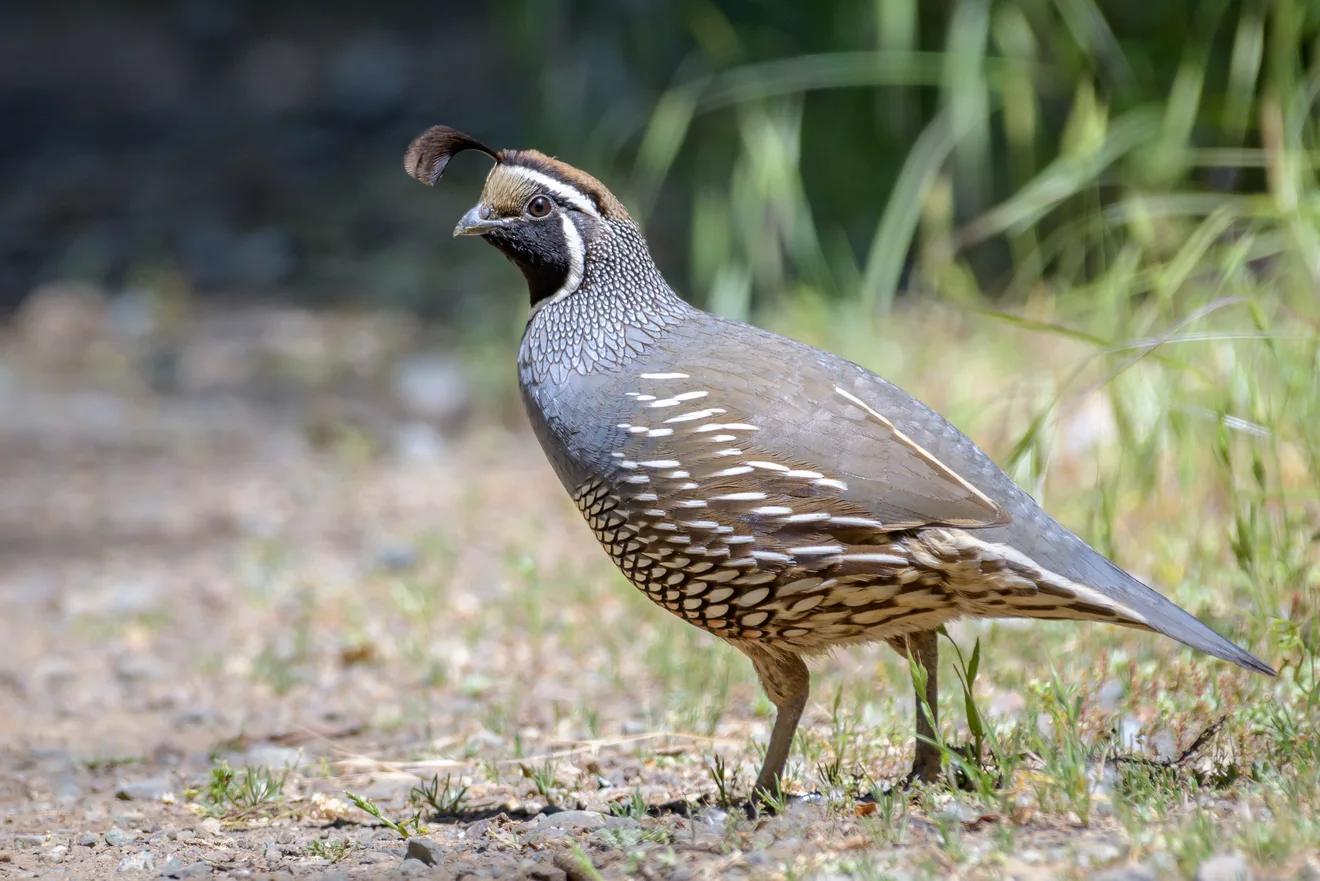
A California Quail is a round, ground-dwelling bird with a forward-curving topknot and a scale pattern on the belly. Males have a black face bordered in white. Females have a shorter plume and a plainer face.
When one quail crosses a trail, wait. During fall and winter, a whole covey may emerge in single file from the same patch of brush.
Identify a bird
Free photo or sound ID. No signup.
On this page7 min read
How to identify a California Quail
The topknot can identify the general type of quail, but check the underside to confirm the species. California Quail show an orderly scaled pattern across the belly and light streaks on the flanks. The male’s white facial lines make a strong contrast against the black throat.
Females and young birds have more subdued markings. A covey usually offers more than one angle. Watch an open strip beside cover for the group to cross without pushing the birds out of the brush.
Find the field marks
Choose a marker to see what to look for.- Curving topknot
The plume rises above the forehead, then curves forward. Other quail can share this shape.
- Scaled belly
Dark edges on the lower feathers form a regular pattern below the plain upper breast.
Male in open ground
Look for white lines tracing the dark face, then shift down to the scaled feathers across the lower belly. If the bird walks behind a grass stem, wait until it clears the cover before judging the belly pattern.
Female at the back of a covey
A female can look plain gray-brown from a distance. Her shorter crest still curves forward, and a side view may show pale streaking on the flank. Watching a line of birds cross a trail can reveal several plumages together.
Quail that runs into brush
The only clear clues may be a round body, a bobbing plume, and the way several birds follow the same path. A brief look at the head puts you in the right group. The face and belly are the next checks for species.
Size and wingspan
- Length
- 9.4–10.6 in
- Wingspan
- 12.6–14.6 in
- Weight
- 4.9–8.1 oz
Measurements from Audubon’s field guide.
California Quail sounds
The familiar three-part call is often compared to Chicago, with the middle syllable highest. A bird may give it when separated from others or when the covey is moving. Listen for an answer from a different direction.
A male may call from a low perch, while other birds stay out of sight. If you hear the call several times, check exposed branches and fence posts next to low brush.
Jonathon Jongsma · converted to MP3 · CC BY-SA 3.0 · Browse more bird calls
What to listen for
A single three-part call can come from deep inside cover. Pause where you are and listen for a reply from a different position. Scan an exposed low branch or post near each sound without walking into the cover.
Reported California Quail sightings
Contiguous U.S. · 2020–2024- 0
- <2
- 2–<10
- 10–<25
- 25–<60
- 60+
Reports by month
Show the data table
| Month | Reports | Per 10,000 |
|---|---|---|
| January | ||
| February | ||
| March | ||
| April | ||
| May | ||
| June | ||
| July | ||
| August | ||
| September | ||
| October | ||
| November | ||
| December |
State colors show sightings per 10,000 bird reports, adjusted for differences in reporting by place and month. Use the rates to compare reports across the map. Data from Cornell’s eBird Observation Dataset via GBIF (CC BY 4.0) with U.S. Census Bureau state boundaries. See the species on eBird.
Where and when to look in the U.S.
In the western U.S., check California oak woodland, chaparral edges, coastal scrub, and brushy country farther north. The useful combination is ground to forage across with dense cover close enough for the birds to duck into.
The species generally stays in its range throughout the year. Fall and winter coveys can be easier to spot than scattered breeding pairs. Spring calling can help locate a bird hidden in vegetation.
California in October
Find a trail through open oak woodland with brush at the edges. Pause where a strip of bare ground touches shelter. Watch there for a second bird after the first one crosses.
21,451 reports in 2020–2024, or 52.5 per 10,000 bird reports in that state and month.
Show California in October on the mapOregon in May
Try a brushy edge or open patch near shrubs in suitable habitat. In spring, listen from the route for a repeated call and look for a raised perch next to the brush.
11,708 reports in 2020–2024, or 58.2 per 10,000 bird reports in that state and month.
Show Oregon in May on the mapWhat does the California Quail eat?
Quail peck and scratch for seeds, leaves, and other plant material. They also take insects. Look along the transition from shrubs to open soil, where a covey can feed close to cover.
Look where seeds collect
Watch the transition between shrubs and exposed soil. The birds can scratch and peck just outside cover, then run back in. Morning light across the ground can make a quietly feeding group easier to see from the trail.
Nesting and breeding
A female usually lays in a shallow scrape on the ground with a lining of vegetation. Brush, grass, or other cover hides the nest. The young can walk soon after hatching and follow the adults.
After the chicks hatch, more than one family may travel together. If a group runs into cover, wait quietly from the trail and let it choose whether to come back out.
From eggs to young
- Clutch12–16 eggs
The nest is a shallow ground scrape with a lining of vegetation. Overhanging grasses and brush can hide it completely.
- Incubation22–23 days
Adults stay close to cover. Watch from an established path and record any nesting behavior without looking for the scrape itself.
- Mobile chicksSoon after hatching
Downy chicks can leave the nest and follow adults. A family crossing open ground may disappear again within seconds.
Breeding ranges and timing from the Cornell Lab’s life history account.
Behavior
A covey may run quickly when startled. If the birds fly, listen for a short burst of wing noise as they head for shelter. The fast dash across open ground and the round silhouette can be easier to notice than plumage.
A covey can use a loud call to maintain contact while birds are out of sight of one another. If you see one bird hurry into a thicket, keep watching the opening it used. Other members may cross after a pause.
How long can a California Quail live?
The longevity record reported by the Cornell Lab is 6 years, 11 months. Individual birds often live much shorter lives.
Conservation
California Quail can live near people where patches of brush remain. Open ground next to thick cover gives a covey a place to feed with an escape route close by.
California Quail or Gambel’s Quail?
The topknots can look alike. A male Gambel’s Quail has a black belly patch and usually stronger chestnut tones on the sides. Look for a scaled belly on California Quail, and check whether you are in desert habitat where Gambel’s is more likely.
| Clue | California Quail | Gambel’s Quail |
|---|---|---|
| Male’s belly | Prominent scaled pattern on the lower belly. | A dark central belly patch is often visible. |
| Flanks | Pale streaks over grayer or brownish sides. | Often stronger chestnut tones with pale streaks. |
| Setting | Brushy woodland and scrub, especially along the Pacific states. | Desert scrub and washes in the Southwest are typical. |
California Quail quick facts
- Scientific name
- Callipepla californica
- Family
- Odontophoridae
Common questions
Is the California Quail the California state bird?
Yes. California designated the California Quail as its state bird in 1931. It is also known as the valley quail.
Do female California Quail have a topknot?
Yes. Their plume is usually shorter and less conspicuous than the male’s, and the face lacks the male’s strong black-and-white pattern.
Sources and credits
- Audubon field guide for field marks, measurements, habitat, diet, and nesting.
- Cornell Lab’s All About Birds species profile for longevity and life history.
- Cornell Lab of Ornithology’s eBird species account for occurrence and species reference material.
- Lead photo by Becky Matsubara · CC BY 2.0 · resized.
- Recording by Jonathon Jongsma · converted to MP3 · CC BY-SA 3.0.
- Cabrillo National Monument for the flock contact call and field marks.
- California Department of Fish and Wildlife for the state bird designation.