
American Goldfinch
Spinus tristis
Identify an American Goldfinch in summer or winter, hear its song, and learn when to look for it at feeders and in weedy fields.

The short answer
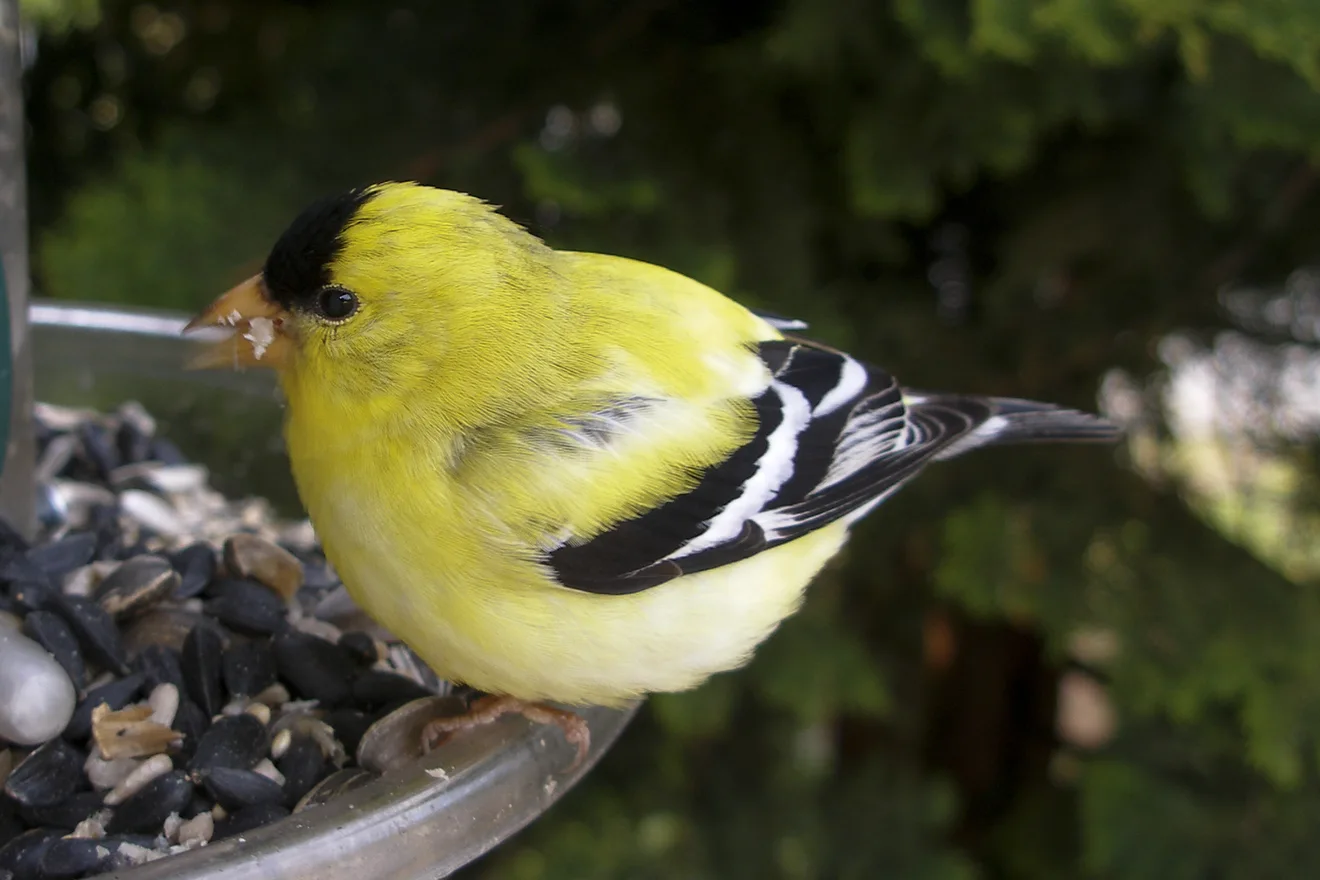
A breeding male American Goldfinch is vivid yellow with a black forehead and black wings marked with white. Females and winter birds are duller. Look for a short conical bill, pale wing bars, and a small notched tail.
The bird on a thistle may be yellow in July and brownish in January. Start with the bill and wings if you want to recognize a goldfinch in either season.
Identify a bird
Free photo or sound ID. No signup.
On this page7 min read
How to identify an American Goldfinch
In spring and summer, the male’s black forehead and white markings on the black wings make the yellow body distinctive. Females are usually more olive or yellow-brown, with darker wings. A small bird holding onto a swaying seed head can offer a good side view of the wing bars.
In winter, use the short seed-cracking bill and a mostly plain breast. The wing bars often stand out even when the yellow is faint. In a flock, compare several birds because some keep more yellow around the head than others.
Find the field marks
Choose a marker to see what to look for.- Black forehead
On a breeding male, the black patch sits just above the bill and eye. The crown behind it stays yellow.
- Pale wing bars
The black wing has contrasting white bars and edges. In winter these can remain obvious when body color has faded.
A yellow male with a dark forehead
The dark patch sits on the forehead, so it can disappear from view when the bird turns away. Check the pale cuts across the folded black wing and the white near the base of the tail if the head is hidden.
Dull birds in fall and winter
A grayish finch can still be a goldfinch. Let it face you long enough to see whether the breast is plain or streaked. Look from the front for the deep base of the bill and from the side for the short point.
A flash of yellow in a flock
Watch where the yellow appears. A siskin can flash yellow in the wings or tail even when the body looks brown and striped. Aim your binoculars where the birds land and compare the chest and bill on the same individual.
Size and wingspan
- Length
- 4–5 in
- Wingspan
- 8–9 in
- Weight
- 0.4–0.7 oz
Measurements from Audubon’s field guide.
American Goldfinch sounds
Goldfinches often give a quick, lilting call in flight. Listen for a few syllables repeated as a bird rises and dips toward the next patch of plants.
The song runs longer, with a mix of light twitters and higher notes. A bird singing from a perch can keep going after the rest of a flock moves through.
Jonathon Jongsma · converted to MP3 · CC BY-SA 3.0 · Browse more bird calls
What to listen for
First listen without looking up. A short group of bright notes that repeats as the flock passes is more useful for locating it than a single chip. Once a bird settles, a run of varied twitters from the same perch is more likely to be song.
Reported American Goldfinch sightings
Contiguous U.S. · 2020–2024- 0
- <60
- 60–<140
- 140–<220
- 220–<300
- 300+
Reports by month
Show the data table
| Month | Reports | Per 10,000 |
|---|---|---|
| January | ||
| February | ||
| March | ||
| April | ||
| May | ||
| June | ||
| July | ||
| August | ||
| September | ||
| October | ||
| November | ||
| December |
State colors show sightings per 10,000 bird reports, adjusted for differences in reporting by place and month. Use the rates to compare reports across the map. Data from Cornell’s eBird Observation Dataset via GBIF (CC BY 4.0) with U.S. Census Bureau state boundaries. See the species on eBird.
Where and when to look in the U.S.
Look in open habitats with seed-bearing plants across much of the contiguous U.S. Weedy fields, stream edges, and gardens with sunflowers can all hold goldfinches. Look at the tops of the plants and watch for stems moving as birds land.
In winter, follow flocks between seed heads and feeders. Summer birds are easiest to recognize in breeding plumage. Choose a state and month on the sightings map to see how local reporting rates change through the year.
Wisconsin in July
Follow paths beside unmown fields and wet meadow edges. Start at the first patch with ripening seed heads and trace any rising and dipping flight back to the stalk where the bird lands.
38,217 reports in 2020–2024, or 352.2 per 10,000 bird reports in that state and month.
Show Wisconsin in July on the mapNorth Carolina in January
Try a weedy edge next to a wooded yard or garden. Scan resting birds between feeding bouts for white wing bars and an unstreaked chest, since a flock in January may have very little obvious yellow.
20,120 reports in 2020–2024, or 171.6 per 10,000 bird reports in that state and month.
Show North Carolina in January on the mapWhat does the American Goldfinch eat?
American Goldfinches feed mostly on seeds. They can hang from small stems to pull seeds from thistles, asters, and other plants. At a feeder, watch for a small finch taking nyjer or sunflower rather than searching the ground for insects.
Find a feeding perch
Check the exposed seed heads of thistle and composite flowers before looking in the canopy. Notice whether the bird stays balanced on a swaying head while pulling seeds, or drops to the ground to work through fallen seed.
Nesting and breeding
Goldfinches breed relatively late for a songbird. They build a small cup in a shrub or tree and line it with soft plant fibers, including down from plants such as thistles.
Their late nesting overlaps with a period when many plants have ripe seed and down. Parent birds feed the young mainly on seeds.
From eggs to young
- Clutch2–7 eggs
The cup is small enough to miss among leaves. Look for adults carrying pale plant down toward a shrub rather than scanning for a large stick structure.
- Incubation12–14 days
The female tends the eggs. Visits by adults can be brief and the nest itself can stay hidden behind the foliage.
- Young in the nest11–17 days
Parents feed the nestlings a mostly seed-based diet. This is one reason summer plants with ripe seeds matter as much as early spring flowers.
Breeding ranges and timing from the Cornell Lab’s life history account.
Behavior
A goldfinch’s flight often has a rolling pattern, with flaps followed by a short dip. Outside the breeding season, several goldfinches may forage together and move between patches of seed.
When a group takes off together, use the flock’s direction and wait at the next weedy patch rather than tracking a single bird against the sky. The best check usually comes when one or two birds land on the edge of the group and turn toward you.
How long can an American Goldfinch live?
The longevity record reported by the Cornell Lab is 10 years, 9 months. Individual birds often live much shorter lives.
Conservation
Leaving some plants standing after flowering gives goldfinches seed to forage on as it ripens. Open patches with seed-bearing plants are useful even within developed areas.
American Goldfinch or Pine Siskin?
Check the breast and bill on a dull winter bird. A Pine Siskin is heavily streaked and has a finer, more pointed bill. A goldfinch usually has a plain breast, a shorter conical bill, and clearer pale wing bars.
| Clue | American Goldfinch | Pine Siskin |
|---|---|---|
| Breast | Mostly plain, even when its plumage is brownish. | Streaks run down much of the breast and sides. |
| Bill | Short, triangular, and deep at the base. | Slender and sharp-looking, even on a side view. |
| Yellow | Prominent across a breeding male’s body. | Often confined to flashes in the wings and tail. |
American Goldfinch quick facts
- Scientific name
- Spinus tristis
- Family
- Fringillidae
Common questions
Do American Goldfinches turn brown in winter?
Many become olive-brown or grayish outside the breeding season. Look for pale wing bars and a thick, short bill when the bright yellow is gone.
Why do American Goldfinches nest late?
Its breeding season overlaps with the supply of ripe seeds and plant down. The birds use seeds as food and plant fibers to line the nest.
Sources and credits
- Audubon field guide for field marks, measurements, habitat, diet, and nesting.
- Cornell Lab’s All About Birds species profile for longevity and life history.
- Cornell Lab of Ornithology’s eBird species account for occurrence and species reference material.
- Lead photo by Thomas Quine · resized and converted to WebP · CC BY 2.0 · resized.
- Recording by Jonathon Jongsma · converted to MP3 · CC BY-SA 3.0.