
Great Blue Heron
Ardea herodias
Identify a Great Blue Heron by its long legs and folded neck in flight. Hear its call and learn where to watch it hunt and nest in the U.S.

The short answer
A Great Blue Heron is a tall, gray-blue wader with a long, pointed bill. In flight, it usually tucks its neck into an S and trails its legs behind. A crane typically flies with its neck extended.
If a shape on the shoreline barely moves, look again before walking past. A Great Blue Heron can stand almost motionless between sudden strikes at prey.
Identify a bird
Free photo or sound ID. No signup.
On this page7 min read
How to identify a Great Blue Heron
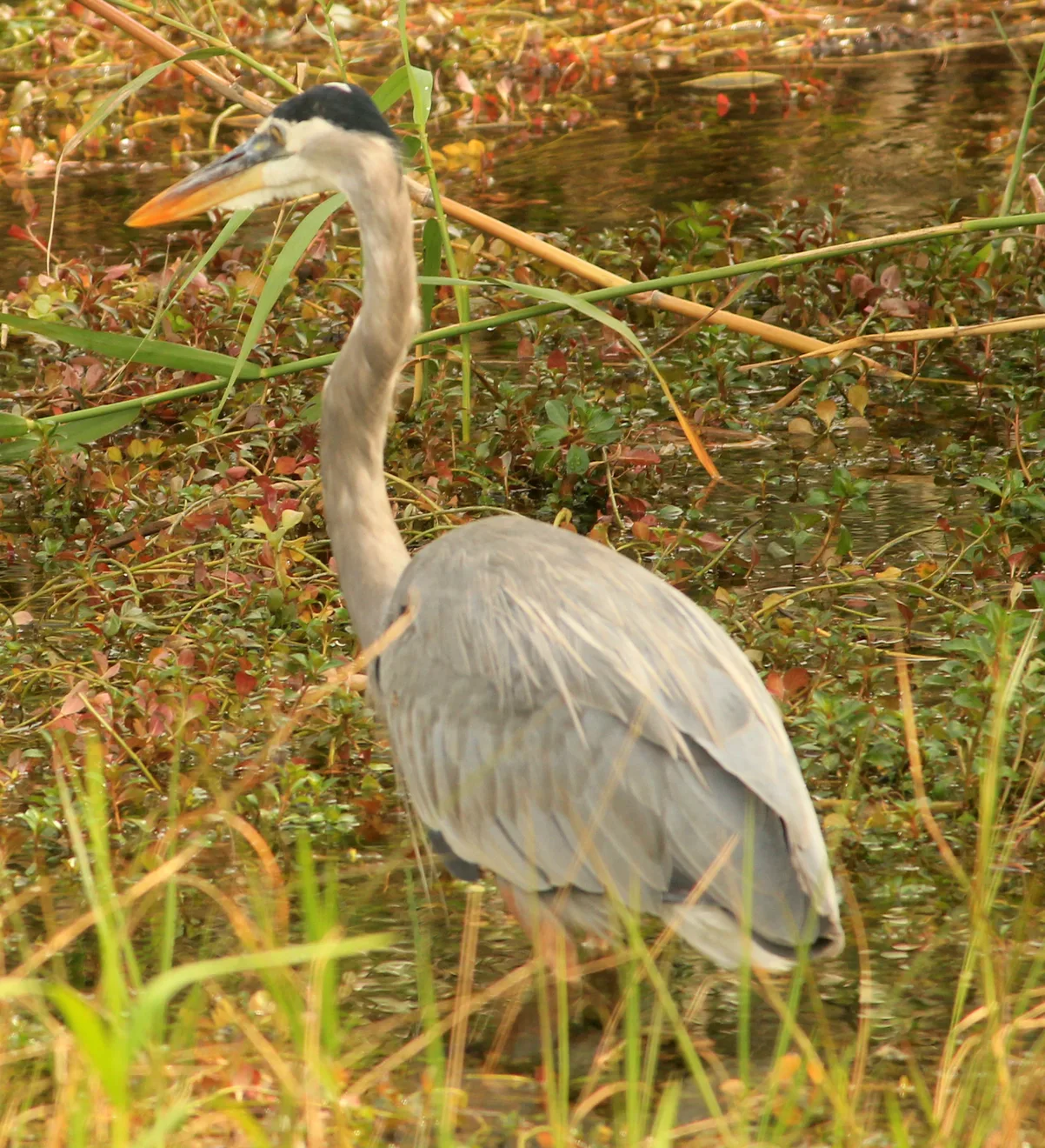
At rest, look for a long dagger-like bill and a slender neck rising from a bulky, blue-gray body. Adults often show a bold dark stripe above the eye on a paler face. Juveniles can look duller and less sharply marked on the head.
Use the flight outline at a distance. The folded neck changes the whole silhouette, and the feet extend behind the tail. Watch for slow, deep wingbeats as the bird crosses the water.
Find the field marks
Choose a marker to see what to look for.- Pointed bill
The long, straight bill projects well ahead of the head and gives a resting heron a distinctive outline.
- Fold in the neck
The long neck can compress into a tight curve. In flight it folds closer to the body.
A heron standing still
Find the bill first. It points forward like a blade even when the head pulls down close to the shoulders. The long legs and subtle slate coloring stand out if you scan the narrow band of shoreline separately from the more distant vegetation.
Adult and juvenile at the same pond
An adult often has a pale crown with a strong dark stripe behind the eye and long feathers along the chest. A juvenile usually looks grayer on the crown and duller in the bill. Compare the head pattern only when the birds are in similar light.
The overhead view
Watch it for several wingbeats. The head sits near the shoulders and the feet project behind a slowly moving, broad-winged body. A straight neck and trailing legs together point you toward a crane or another long-legged bird.
Size and wingspan
- Length
- 3 ft 2 in–4 ft 6 in
- Wingspan
- 5 ft 6 in–6 ft 7 in
- Weight
- 4 lb 10 oz–5 lb 8 oz
Measurements from Audubon’s field guide.
Great Blue Heron sounds
The call is a rough squawk or croak. You may hear it when a bird takes off or at a nesting colony. A heron actively hunting along a pond edge may stay silent.
If a loud croak comes from a marsh, check over the water and above the trees. An adult moving between a feeding spot and a roost can pass overhead before you see it on the bank.
National Park Service · U.S. public domain · converted to MP3 · Browse more bird calls
What to listen for
A sudden croak can mark the moment a bird lifts off. If its source is hidden behind reeds, look across the water and then just above the tallest vegetation. At a colony several callers can overlap, which makes the direction less obvious.
Reported Great Blue Heron sightings
Contiguous U.S. · 2020–2024- 0
- <5
- 5–<25
- 25–<75
- 75–<150
- 150+
Reports by month
Show the data table
| Month | Reports | Per 10,000 |
|---|---|---|
| January | ||
| February | ||
| March | ||
| April | ||
| May | ||
| June | ||
| July | ||
| August | ||
| September | ||
| October | ||
| November | ||
| December |
State colors show sightings per 10,000 bird reports, adjusted for differences in reporting by place and month. Use the rates to compare reports across the map. Data from Cornell’s eBird Observation Dataset via GBIF (CC BY 4.0) with U.S. Census Bureau state boundaries. See the species on eBird.
Where and when to look in the U.S.
Search shallow freshwater and saltwater edges across much of the U.S. A slow river bend, tidal flat, pond, or marsh channel can all hold a fishing bird. Scan from the nearest bank to the far shoreline, where a stationary bird can blend into the vegetation.
Where lakes and marshes freeze, many birds move south or toward open water. Mild coastal areas can hold herons throughout the year. At an estuary, try watching when the tide exposes shallow edges.
Florida in February
Check a marsh edge or shallow estuary from a boardwalk or shoreline path. At tidal sites, scan newly exposed channels and pools where fish collect as water drops.
56,836 reports in 2020–2024, or 178.4 per 10,000 bird reports in that state and month.
Show Florida in February on the mapWashington in July
Try a bay or river mouth at a time when the shore is visible. Sweep the shallows slowly and look for a tall shape casting a reflection among smaller shorebirds.
19,425 reports in 2020–2024, or 149.1 per 10,000 bird reports in that state and month.
Show Washington in July on the mapWhat does the Great Blue Heron eat?
Great Blue Herons catch fish and also take frogs, crustaceans, and other small animals. Watch how a heron holds still, moves one foot at a time, then strikes with the bill. Some forage away from water, including in open fields.
Watch for the strike
A heron can wait motionless and then extend the neck in a fraction of a second. Keep the head in view, even if the body seems too still to be feeding. In shallow water you may also see it walk slowly and pause after each step.
Nesting and breeding
Many Great Blue Herons raise young in colonies. Pairs build substantial stick platforms, often high in trees near water. A colony can look like a cluster of dark baskets before the leaves come out.
Adults share incubation and carry food back for the young. Watch from public paths or overlooks. A long view is often better for watching the birds arrive than standing beneath the nest trees.
From eggs to young
- Clutch2–6 eggs
The bulky stick platform often sits high in a tree. At a colony one large tree can hold more than one pair.
- Incubation27–29 days
Both parents can share incubation. A stationary bird may sit low enough for the nest edge to hide it.
- Young in the nest49–81 days
The young remain in the nest for weeks. From a public viewpoint you may see heads appear above the sticks when a parent returns.
Breeding ranges and timing from the Cornell Lab’s life history account.
Behavior
A heron you see fishing alone may breed near many neighbors. The feeding and nesting habitats can be separated, so watch birds leaving the water if you want to understand how they move through a site.
The same bird can fish alone for much of the day and fly toward a colony or communal roost later. A stream of birds flying along the same line at dusk can be easier to follow than the silently hunting birds you saw at midday.
How long can a Great Blue Heron live?
The longevity record reported by the Cornell Lab is at least 24 years, 6 months. Individual birds often live much shorter lives.
Conservation
Shallow wetlands support feeding birds, while mature trees near water may support nesting colonies. Give active colonies space and use established viewing areas.
Great Blue Heron or Sandhill Crane?
Look at the neck in flight. A crane usually holds the neck straight. An adult Sandhill Crane also has a red crown and spends more time on open ground. The heron’s blade-like bill and stalking posture help confirm it at the water’s edge.
| Clue | Great Blue Heron | Sandhill Crane |
|---|---|---|
| Neck in flight | Usually tucked close to the shoulders. | Usually extended, with the head well ahead of the body. |
| Bill | Long, pointed bill used for fast strikes. | Straighter-looking bill for probing and picking up food. |
| Adult crown | Pale crown with a dark stripe toward the rear. | Often shows a patch of red over the forehead and crown. |
Great Blue Heron quick facts
- Scientific name
- Ardea herodias
- Family
- Ardeidae
Common questions
Can a Great Blue Heron be white?
Yes. The Great White Heron is a white form found mainly in southern Florida and the Keys. Check its robust build and pale legs when comparing one with a Great Egret.
Do Great Blue Herons nest on the ground?
Most build stick nests in trees or shrubs, but some nest on the ground in places with few ground predators.
Sources and credits
- Audubon field guide for field marks, measurements, habitat, diet, and nesting.
- Cornell Lab’s All About Birds species profile for longevity and life history.
- Cornell Lab of Ornithology’s eBird species account for occurrence and species reference material.
- Lead photo by Yinan Chen · public domain · resized.
- Recording by National Park Service · U.S. public domain · converted to MP3.