

Northern Flicker
Colaptes auratus
Identify a Northern Flicker by its spotted belly, black chest crescent, and white rump. Compare eastern and western forms, hear its call, and find nesting and seasonal clues.
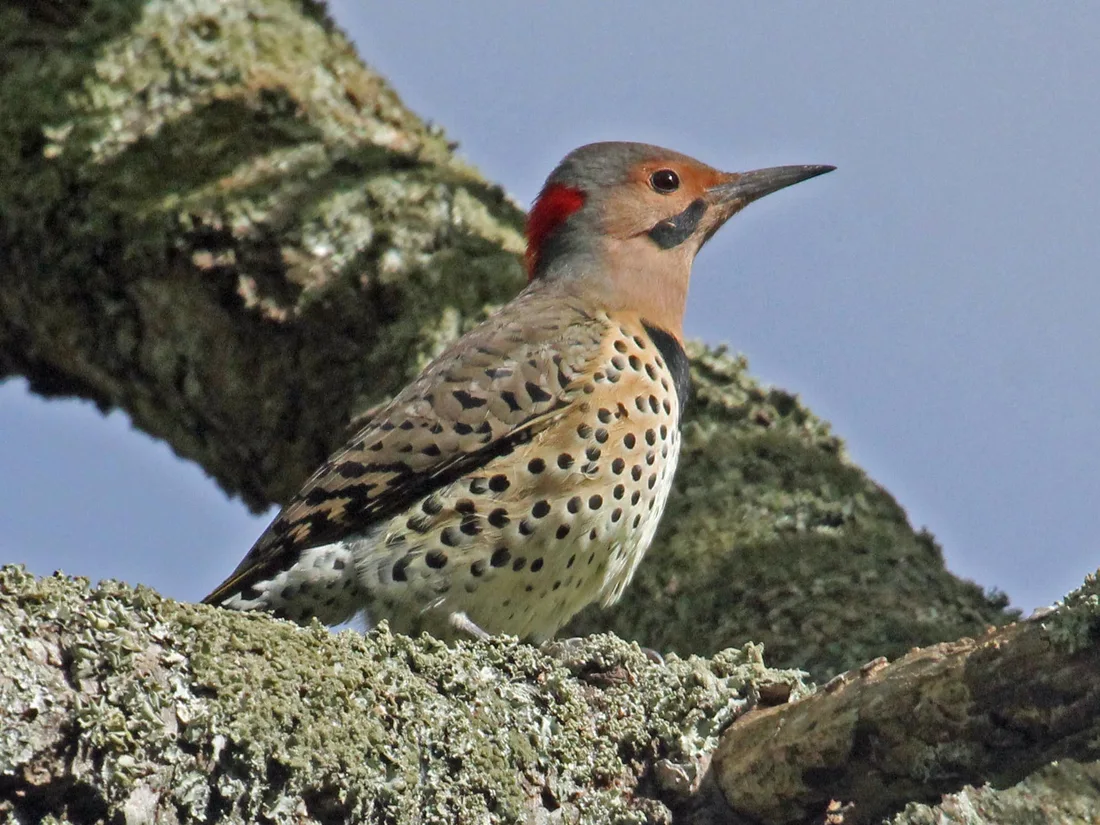

The short answer
Look for a spotted belly, a black crescent on the chest, and a white rump visible in flight. A Northern Flicker often feeds on the ground, so a brown bird probing for ants on a lawn could be a woodpecker.
If a flicker flies before you see its belly, watch for the white rump. Its wing color can help you tell the regional forms apart, but the rump is useful in both eastern and western birds.
Identify a bird
Free photo or sound ID. No signup.
On this page8 min read
How to identify a Northern Flicker
Flickers show round spots below and narrow bars across the back. The white rump stands out against a brown or gray back as the bird flies away. The dark chest crescent is most useful when the bird turns toward you.
Find the field marks
Choose a marker to see what to look for.- Red nape mark
This yellow-shafted bird has red at the back of the head. Check regional form when comparing the red markings on flickers.
- Round breast spots
Distinct rounded spots extend across the underside. These help when the wing-shaft color is hidden.
Spotted woodpecker on a lawn
Check for round dark spots under a broad chest crescent. The back is barred, so a rear view alone can suggest another woodpecker. Wait for the bird to turn as it probes the ground, then check the underside.
Age from a close view
The face is often easier to see than the wing shafts on a perched bird. Young flickers can look softer and less sharply marked than adults. Use the separate juvenile guide when age matters and the photograph shows only part of the head.
Can I tell which form it is with the wings closed?
With a good side view, sometimes. Start at the back of the head. A typical yellow-shafted adult has a red crescent at the nape, a tan face, and a gray crown. A typical red-shafted adult has a gray face, a browner crown, and usually no red crescent. On a male, check the stripe that runs back from the bill. It’s black on a typical yellow-shafted bird and red on a typical red-shafted one. Females of both forms lack the stripe, so compare the face, crown, and nape together.
In the Great Plains and other areas where the forms meet, a bird can show traits of both. Try to see the underside of the tail from your current spot. If the bird takes off, watch beneath the wings for a flash of yellow or salmon-red. When the head and flight colors give mixed signals, recording Northern Flicker at the species level is a reasonable call.

Size and wingspan
- Length
- 11–12 in
- Wingspan
- 17–20 in
- Weight
- 4–6 oz
Measurements from Audubon’s field guide.
Northern Flicker sounds
Listen for a long run of rapidly repeated notes or a single emphatic call. The sustained vocalization can resemble a Pileated Woodpecker, especially if you only hear part of it.
Flickers also drum. That short roll comes from the bill striking a resonant surface, such as a branch or metal fixture. Look for the bird on a visible perch if the sound is coming from the same spot repeatedly.
National Park Service · U.S. public domain · Browse more bird calls
What to listen for
A single long call can carry across an opening. Pause through the next call and watch for movement along the trees. A rapid drum comes from the bill striking a surface and can sound very different when the bird changes from wood to a resonant structure.
Reported Northern Flicker sightings
Contiguous U.S. · 2020–2024- 0
- <5
- 5–<25
- 25–<75
- 75–<150
- 150+
Reports by month
Show the data table
| Month | Reports | Per 10,000 |
|---|---|---|
| January | ||
| February | ||
| March | ||
| April | ||
| May | ||
| June | ||
| July | ||
| August | ||
| September | ||
| October | ||
| November | ||
| December |
State colors show sightings per 10,000 bird reports, adjusted for differences in reporting by place and month. Use the rates to compare reports across the map. Data from Cornell’s eBird Observation Dataset via GBIF (CC BY 4.0) with U.S. Census Bureau state boundaries. See the species on eBird.
Where and when to look in the U.S.
Search woodland edges, yards, parks, and open ground beside trees across much of the U.S. Places with both ant-rich ground and potential nest cavities can hold flickers. Start at the edge of a lawn instead of scanning the densest part of a forest.
Northern populations are more migratory, while some western birds move shorter distances or descend from higher elevations. Check monthly reports for your state before assuming your local flickers stay year-round.
Massachusetts in October
In fall, start at a lawn or open grassy slope next to trees. Scan the ground for feeding birds, then watch a bird that flies away for the white rump and a flash of yellow beneath the wings.
20,995 reports in 2020–2024, or 153.4 per 10,000 bird reports in that state and month.
Show Massachusetts in October on the mapColorado in June
Try the edge of an open woodland or a break in mountain trees with short vegetation nearby. If a red flash comes from under the wing, also check the spotted underside and rump before deciding on the species.
26,466 reports in 2020–2024, or 206.7 per 10,000 bird reports in that state and month.
Show Colorado in June on the mapWhat does the Northern Flicker eat?
Ants are a major part of the diet. A flicker probes the soil or a rotting log with its bill and uses its long tongue to reach prey. It also takes other insects and eats some fruit and seeds.
Find a bird working an ant patch
Watch for a woodpecker that inserts its bill repeatedly into the same small patch of grass or soil. This feeding habit makes flickers easier to see in open ground than several other familiar North American woodpeckers.
Nesting and breeding
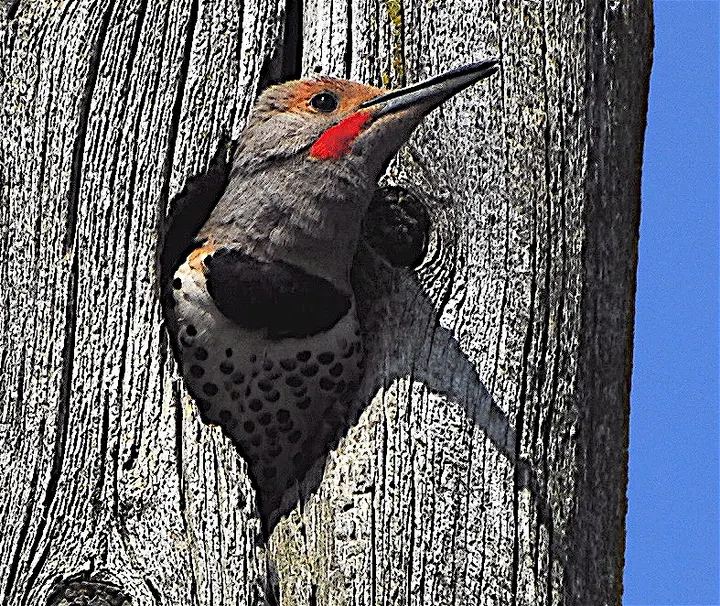
A pair typically uses a cavity in a tree or similar structure. Flickers can excavate their own holes, and the remaining cavities can be used by other birds after the nest is vacated.
Both parents care for the young. An adult visiting with food gives a stronger clue to a fledgling’s age than wing color, which varies with regional form.
From eggs to young
- Clutch5–8 eggs
The pair excavates a cavity, often in softened wood. A round opening is a starting clue and repeated visits help identify its occupant.
- Incubation11–13 days
A flicker’s activity at the cavity may be sporadic while the eggs are being tended.
- Young in the cavity24–27 days
Toward fledging, young birds can become easier to detect from a route with a clear view of the opening.
Breeding ranges and timing from the Cornell Lab’s life history account.
Behavior
A flicker may perch upright on a trunk, then drop to the ground to feed. If you lose it among the trees, glance down at nearby grass or a bare patch of soil before giving up the search.
Look at a bird departing from a lawn and see whether it flies straight to a trunk. The move can reveal both the white rump and the woodpecker’s vertical posture in one short observation.
How long can a Northern Flicker live?
The longevity record reported by the Cornell Lab is at least 9 years, 2 months for a yellow-shafted bird. Individual birds often live much shorter lives.
Conservation
Audubon California identifies declining flicker populations in open woodland and points to dead and dying trees as important places for nesting cavities. Keeping safe cavity trees preserves a resource that other birds use too.
Northern Flicker or Red-bellied Woodpecker?
A Red-bellied Woodpecker has even black-and-white barring across its back and much plainer underparts. On a flicker, the spotted belly and dark chest crescent are better clues than a red patch on the head.
| Clue | Northern Flicker | Red-bellied Woodpecker |
|---|---|---|
| Underparts | Round dark spots under a broad dark chest crescent. | Usually plain below, with a faint reddish wash on the belly. |
| Back | Bars visible above, with white on the rump in flight. | Even, sharply defined black-and-white barring across the back. |
| Feeding | Frequently probes lawns or exposed soil for ants. | Often works branches and trunks or visits a feeder. |
Juvenile Northern Flicker guide
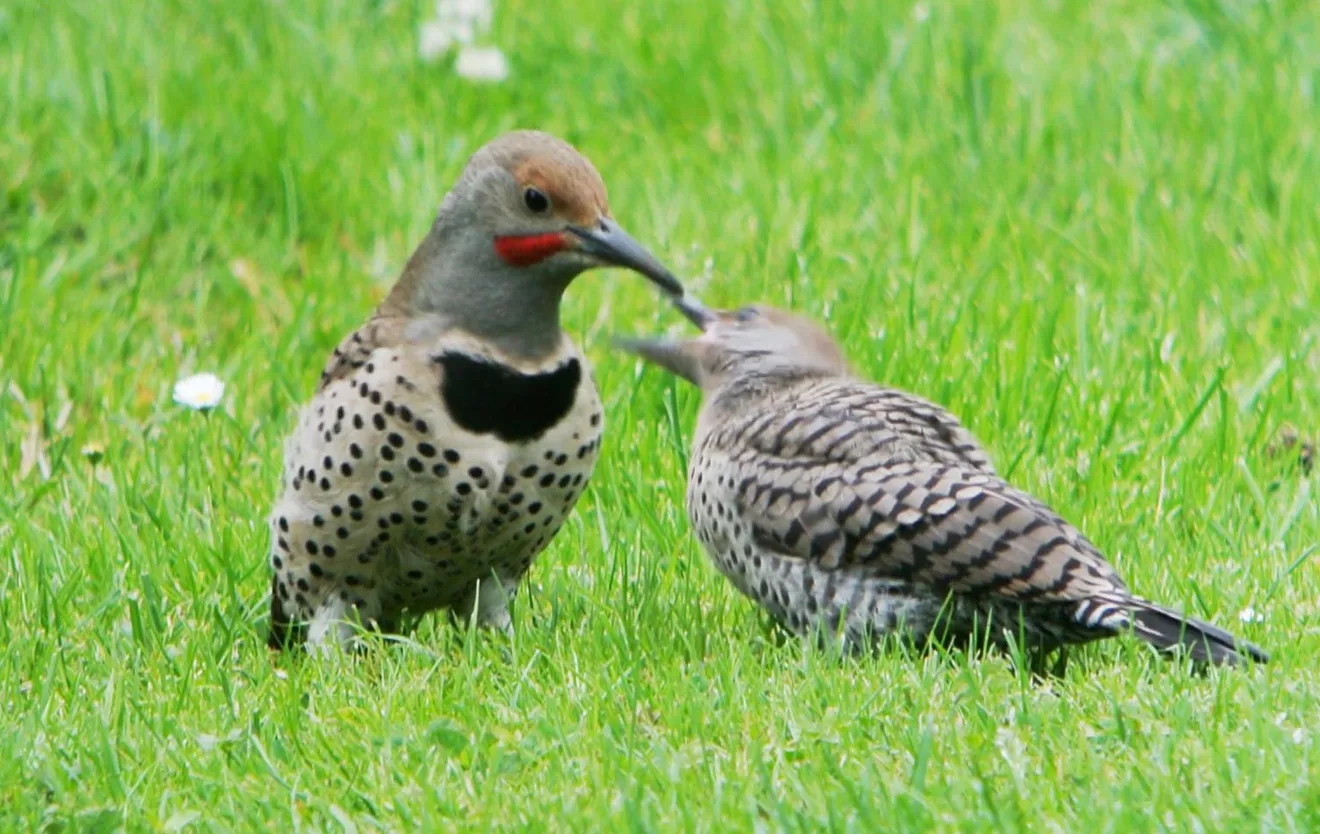 Juvenile Northern Flicker identificationCompare field marks, regional forms, and signs of a recent fledgling.
Northern Flicker quick facts
- Scientific name
- Colaptes auratus
- Family
- Picidae
Common questions
Are red-shafted and yellow-shafted flickers different species?
They are regional forms of Northern Flicker. They interbreed where their ranges meet, so some birds show a mix of traits.
Why is a woodpecker hopping around on my lawn?
It may be a Northern Flicker searching for ants. Check for a spotted belly and the white rump if it flies.
Sources and credits
- Audubon field guide for field marks, measurements, habitat, diet, and nesting.
- Cornell Lab’s All About Birds species profile for longevity and life history.
- Cornell Lab of Ornithology’s eBird species account for occurrence and species reference material.
- Lead photo by Dick Daniels · CC BY-SA 3.0 · resized.
- Recording by National Park Service · U.S. public domain.
- Juvenile guide thumbnail by Andy Reago and Chrissy McClarren · CC BY 2.0 · cropped and resized.
- Audubon California’s conservation profile for nesting habitat and population trends.
